


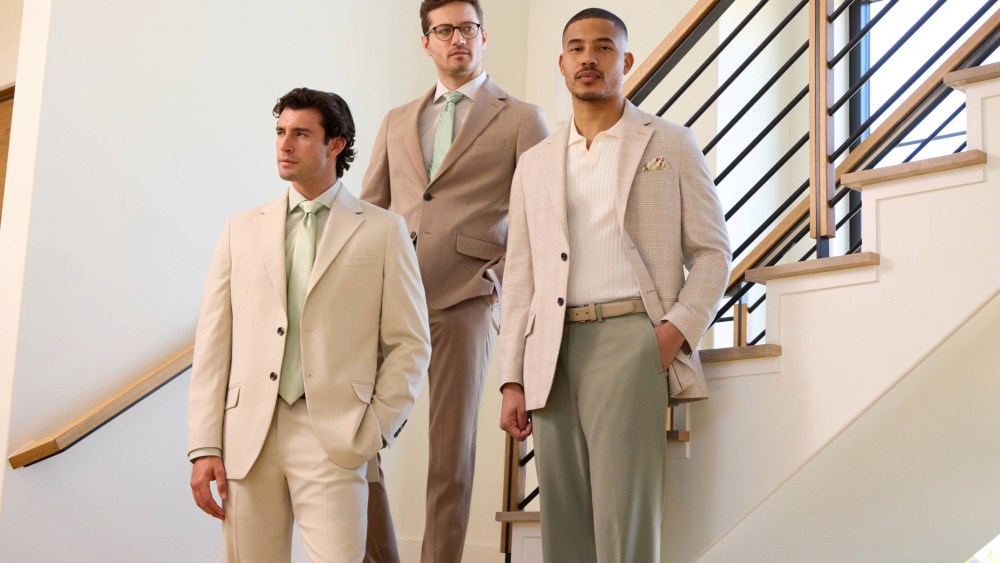

Since its founding in 1926, Haggar has become part of the fabric of American life. The brand has the nation’s number-one-selling dress pant, suit separate pant, sport coat and suit separate jacket. The company has annual sales of over $750 million.
Now owned by Randa Apparel & Accessories, Haggar has plans to continue to expand its reach both in the U.S and internationally, and is also considering a higher-end collection as it looks ahead to its next 100 years.
But its history is much more humble.
Joseph Marion Haggar was born in Lebanon to a very poor family. His father died when he was 2 and, when he turned 14 in 1906, he decided to stow away on a cattle boat headed to North America.
J.M. Haggar in the factory.
Courtesy

He landed in Mexico and began working as a traveling overalls salesman, a career that would ultimately define his life. After settling in Dallas in the early 1920s, he made the decision to start his own pant company.
As current Haggar chief executive officer Michael Stitt relates: “As a salesman, he would always go into a store and haggle over each order. So he said, ‘This is ridiculous. I’m going to start a company, and I’m going to set one fair price for everyone.’ So that was his impetus to change things right out of the gate.”
Haggar, known as J.M., started his company in a one-room office with four employees and two sewing machines. And within two years, the company was producing 75,000 pants, according to Stitt.
Over the years, the Haggar company has amassed an enormous amount of firsts, including the first hemmed pant, the first stretch waistband, the first machine washable suit, the first fully recyclable dress pant, the first wrinkle-free pant and the first suit separates.
The company holds the patent for more than 50 innovations, including a back pocket fastener that Haggar created to combat rampant pickpocketing in 1946.
It’s thanks to J.M. Haggar that the word “slacks” has become part of the vernacular. The company trademarked the term in 1938 to market pants to soldiers in World War II to wear in their “slack time.”
“I would describe him as a visionary, an entrepreneur, definitely an innovator,” Stitt said.
Haggar had recognized that, with the commercialization of home washing machines in the 1950s, there was an opportunity of people to wash their pants at home instead of at a dry cleaner. Ditto for pre-cuffed finished-hem dress pants, which eliminated the need for a tailor.
“Haggar was also the first menswear company to advertise in print and on TV,” Stitt said. And it was among the first to sponsor sports stars, starting with Mickey Mantle and Arnold Palmer. Since 1978, it has made the Pro Football Hall of Fame Gold Jacket for players being inducted into the Canton, Ohio-based organization.

A vintage shot of the Haggar factory.
Courtesy
For a large part of its history, the Haggar family remained involved in the business, with the brand passing from J.M. to his sons Ed and Joe Jr., and then to Joe Haggar 3rd, who served as CEO until 2005 when the company was sold to Pouchen, a public Taiwan-based footwear manufacturer, and the Perseus private equity firm. Pouchen eventually bought out Perseus and, in 2019, sold the business to Randa.
At that time, Randa was exclusively an accessories manufacturer, which itself boasts 116 years of history. “It was part of our diversification strategy,” said David Katz, executive vice president and chief marketing officer of Randa. “We had gained such large market share in the accessories business, how do you continue to grow? One of the [ways] was to be in the apparel business.”
So while he acknowledged that Randa didn’t have the expertise in apparel, “we understood the distribution. We understood their skill at sourcing, and we knew we had to be in that business.”
Under Randa’s ownership, Stitt, who joined Haggar 27 years ago and has been CEO for 15, has found a benevolent parent with deep pockets that is willing to invest to grow the business.
“It’s not too often you’re a 100-year-old company and you get acquired by a company that’s been around longer,” he said. “But the point being, Randa is very long-term and strategic in all of their thinking.”
Case in point, Haggar is making the single-largest capital investment in its history at its Fort Worth distribution center. “It’s going to be a complete state-of-the-art retrofit with the latest technology, automation, robotics. We’re investing over $50 million, and we’re doing it to improve accuracy, efficiency, scale,” Stitt said. “We’re going to be able to process orders 30 percent faster, and our capacity will increase by 50 percent. We operate and plan the business with a very long-term outlook.”
And Randa’s investment is paying dividends. Stitt said that in 2019, Haggar had a 16 percent market share in dress pants and suit separates. Today, it’s 24 percent. “So essentially, one in four dress or suit pants sold in America is Haggar branded.”

Haggar produces “polished casual” looks.
courtesy
And unit sales of sport coats and suit jackets have risen from a 6 percent market share to 11 percent during same time frame. “It speaks to the benefit of being on the Randa platform and everything associated with that,” he said.
Haggar sells across a wide swath of retailers, from mid-tier merchants such as Kohl’s and JCPenney to department stores such as Macy’s and Belk as well as mass merchants including Target, where it sells under the H26 name, a nod to the centennial.
Last year, the brand created a Pro Football Hall of Fame tailored clothing collection with Kohl’s that is selling well, Stitt said. “And that’s part of our growth initiative right now.”
Tailored clothing is seen as “the biggest growth vehicle for us today,” he said.
“During the pandemic, all the fashion forecasters were saying no one’s going to dress up again. Meanwhile, if you ask virtually any retailer what their best men’s department has been in the last five years, the answer is tailored clothing and dress-up. It has incredible momentum and continuous year-over-year growth.”
It’s being driven by occasion dressing such as weddings, proms and graduations, which he referred to as “annuities,” or recurring events, as well as the propensity for young men to dress up. “Forty-eight percent of Haggar consumers in the last 12 months were between 18 and 44,” he said.

Tailored clothing is seen as a growth opportunity.
Courtesy
Another growth area is in performance product that Haggar refers to as “polished casual,” pieces that can be dressed up or down. One recent win has been Haggar Sport, which features both performance and comfort features. A chino introduced 18 months ago is now the top-selling pant in the mid-tier channel in America in terms of units and dollars, he said.
Katz said international expansion is also in the cards. Currently, the brand is sold in Canada and Mexico but “that still leaves a lot of Randa’s global footprint where Haggar can grow.” That would include the U.K., continental Europe, Asia, Australia and New Zealand.
Expanding category distribution is also a goal. “Over time we expect Haggar as a company to become multibranded the way other companies are” Katz said. “There’s no reason they couldn’t have a brand that would be appropriate for Nordstrom and Bloomingdale’s, and a brand that would be appropriate for Walmart and some other customers. The Haggar name belongs in the channels where it’s the leader right now, but Randa is very good at managing multichannel, multibranded businesses.”
To celebrate the anniversary, Haggar will host a gala in Dallas on Wednesday to honor the brand’s history — and its future.
View the original article here


