


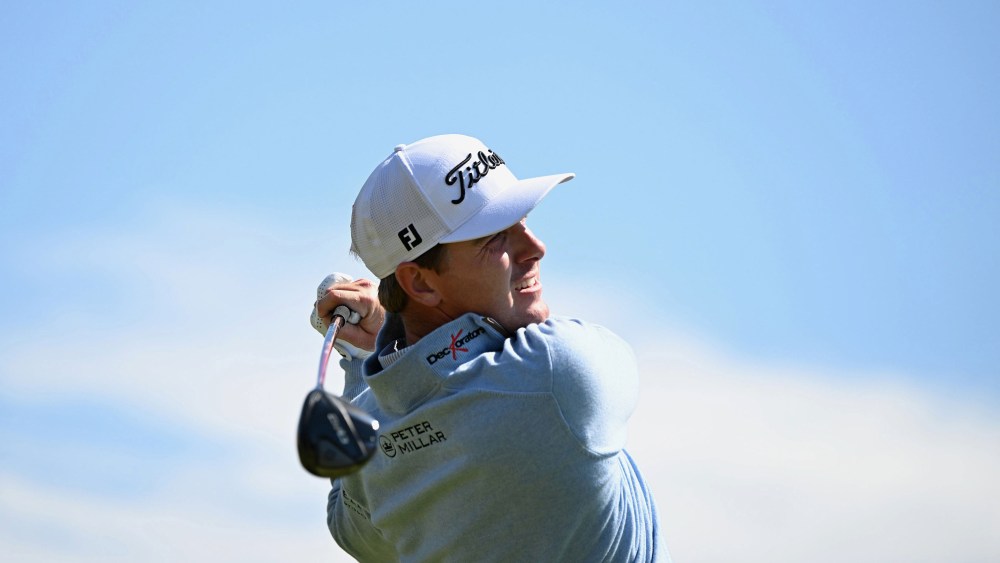

Ryan Gerard is an up-and-comer on the PGA Tour with seven top-10 finishes last year and a third-place ranking in the FedEx Cup standings. He’s also a Raleigh, N.C., native who has close ties to Peter Millar. Here, he talks his past, future and his quest to find a hobby.
WWD: The PGA Tour season is over but you’re still competing in London, France and Japan. Why not take a break?
Ryan Gerard: I’m 27 and in pretty good physical condition. It’s the off-season, but when you have the opportunity to do bucket list stuff and bring golf to cool places that don’t get a lot of it, it makes you want to get out, explore and have some fun.
WWD: You had a strong season last year. Are you happy with how you played?
R.G.: Overall, I’m pleased with how things went. I was a little disappointed to not close with a win, but there were a lot of positive steps in the right direction for next year. I feel very comfortable with my game and where things are and how we’re trending. So from that standpoint, I’m pleased. But the competitor in me always wants more. Golf is a game of misses and you’re always kind of chasing perfection either in the results or the process, and it’s not easy to objectively step back and tell yourself, good job. You’re always looking at what you could have done differently or better.
WWD; So, what will you work on if going into next year?
R.G.: I think a lot of will be physical maintenance of the body. I spent a lot of time this year with a new trainer that I started with halfway through the season, and it was awesome. I gained a lot of physical ability to hit the golf ball further, harder, higher. But with that came a little bit of uncertainty about how far the ball was going, and a little bit less control. So we’re going to work on fine tuning the numbers. And my chipping this year wasn’t nearly as good as it’s been in years past. It had been a strength of mine basically for as long as I can remember, and for some reason this year the shorter shots and I weren’t quite on the same page. So, we’re going to spend a lot of time just making sure I feel comfortable with technique, different grass types, different shot shapes, different mental strategies.

WWD: You had a lot of success on the Korn Ferry tour. How is that different from the PGA?
R.G.: Well, it’s still golf. I would say the quality of courses that you play on the Korn Ferry tour are not quite to the quality of the PGA Tour courses from a difficulty standpoint, and it takes a lot more mental energy and ability to go week in, week out on the PGA Tour and properly diagnose what shots to hit, how to play certain holes, how to stay mentally focused when things get difficult, how to deal with adversity. And the competition on the PGA Tour is a lot deeper. The top of the Korn Ferry Tour is still very, very good, but the 50th best guy on the Korn Ferry Tour and the 50th best guy on the PGA Tour are nowhere near the same. But it’s a training ground for guys trying to get to the next level. It taught me a lot when I was coming up. It teaches you how to be professional, how to think, how to travel, manage your game, manage your people, interpersonal communications with caddy, trainer, agent, whatever it might be.
WWD: Who do you admire in the sport?
R.G.: Tiger Woods is like the greatest golfer of all time, but I really like a guy named Webb Simpson. He’s from Raleigh, N.C., as well, and he did things with his own style. And I can relate to doing things your own way, just being really good at getting the ball in the hole, not overpowering the golf course, not relying too much on one strength, but just being really well rounded as a person and as a player. And then Russell Henley. I feel he’s probably the best all-around golfer on the planet. Scottie Scheffler is the best golf player, Rory McIlroy is incredible. Russell doesn’t hit it very far, but he’s an absolute dog in getting the ball in the hole. And I have so much respect for how consistent he is.
WWD: You mentioned Raleigh, where both you and Peter Millar are from. Is that how you got connected?
R.G.: Peter Millar’s been great to me for such a long time. Scott Mahoney is the CEO, and his son and I actually played on the same high school golf team. As a North Carolina kid, and them being a North Carolina company, we share a lot. And then as I’ve gotten older, I’ve seen the brand grow and expand. Everything they do is quality, but kind of understated, and I feel like that’s my style too. I’m not too flashy. I like to kind of stay under the radar, and I feel like they do a really good job of being quiet about being the best.
WWD: If you’re understated, what do you like to wear?
R.G.: You’re not going to catch me wearing NC State red, or orange pants like my guy Rickie [Fowler]. I like a lot of light blues, navies, white and gray. Things that that go well together, but that aren’t too noisy.
WWD: What do you like to do when you’re not playing golf? Rumor has it you play chess?
R.G.: I kind of go in and out of spurts with chess because it’s a very frustrating game. So I’ll go through three or four weeks where I’ll play it a lot, and then I’ll go through three or four weeks where I’m just sick of it. Beyond that, all my time is spent thinking about golf, looking at golf courses online or watching other people play golf. I need to pick up some hobbies.
Christian McCaffrey, San Francisco 49ers running back
Christian McCaffrey in Peter Millar.
BGM_PHOTOGRAPHY
WWD: How do you blend your on-field style with your personal style off the field?
Christian McCaffrey: It’s about finding pieces that balance performance, comfort and elevated style.
WWD: What role does Peter Millar play in that balance?
C.M.: Peter Millar fits naturally into that balance. The brand has a way of making polished, elevated pieces feel incredibly comfortable and effortless, which is really how I approach my style both on and off the field.
WWD: Who are some of your style inspirations?
C.M.: I’m drawn to clean, classic style. I lean toward pieces that feel timeless.
WWD: Has your personal style evolved as you’ve become more visible in the public eye?
C.M.: I’ve really leaned into classic styles that stand the test of time.
WWD: The NFL tunnel walk has become a significant platform for player expression and fashion. How much do you engage with that aspect of the game, and how do you see Peter Millar fitting into that space?
C.M.: I think fashion is a great form of self-expression. You can say a lot without saying anything. For me, Peter Millar fits into that space through a more refined, understated approach — classic pieces with elevated fabrics and a focus on the details.
Jaccob Slavin, Carolina Hurricanes defenseman

Jaccob Slavin
Courtesy
WWD: How do you meld your on-ice style with your personal one?
Jaccob Slavin: My on- and off-ice style collide in the sense that I’m more of a classy player. I try to play with a lot of integrity and have a high standard for myself.
WWD: How does Peter Millar play a role in this?
J.S.: To me that is exactly how Peter Millar is, high standards, lots of class and a company with great integrity.
WWD: Who are your style stars?
J.S.: I’ve only recently, since partnering with Peter Millar, taken more interest in style. No specific stars in my mind, but a sharp-dressed person.
WWD: How has hockey’s elimination of the dress code changed your wardrobe and is it a good or bad thing for the league?
J.S.: I think it is a good thing for the league. You have your guys who will still wear suits and ties, but also allow some guys to express their style. It has definitely changed my wardrobe for the better. Peter Millar has saved my wardrobe with their lifestyle products when it comes to dressing for games! It has been an amazing partnership.
Sam Burns, PGA Tour golfer

Sam Burns
Courtesy
WWD: How do you meld your on-course style with your personal one?
Sam Burns: For me, it’s all about keeping things pretty simple and comfortable. When I’m out on Tour, I want to feel just as comfortable but look clean and professional. I don’t really try to be too flashy or loud; I just stick to clean lines, classic colors, and fits that let me swing and move naturally. If I feel like myself in the clothes, I usually play better.
WWD: How does Peter Millar play a role in this?
S.B.: Peter Millar makes it incredibly easy, to be honest. They’re the perfect bridge between high-level athletic performance and that classic, timeless look. Their stuff feels amazing when you’re swinging a club — it stretches exactly where it needs to and breathes really well, which is huge when we’re playing in the heat down South — but it still looks tailored. It just fits my lifestyle perfectly.
WWD: Who are your style stars?
S.B.: Out on Tour, there are a lot of guys who dress well, but I always appreciate the guys who keep it traditional and clean. Honestly, I’m way more focused on my golf game than trying to be a fashion icon, but I really respect anyone who looks put-together and honors the traditions of the game.
WWD: What advice would you give designers of golf apparel?
S.B.: Comfort and performance have to come first when competing. Sometimes less is more. Just give us fabrics that stretch and breathe, but keep the patterns and colors versatile. If it looks good, feels comfortable, and performs well when the pressure is on, you’ve got a winning combination.
View the original article here


