



Some designs tell a story not just through what they are, but primarily through what came before them. The Lin jacket is perhaps the most tangible example of this for me. What once began as a limited edition design of organically grown linen from The Linen Project has evolved into a garment that now carries multiple layers of meaning.
Fashion designer Joline Jolink moved from Rotterdam to a farm in Overijssel, the Netherlands, in 2023. There, she founded the Fashion Farm. Here, she experiments with raw materials for textiles that can be grown and processed on Dutch soil. As a guest author for FashionUnited, she takes you on a journey from seed to garment in this series, ‘Diary of a pioneer’.
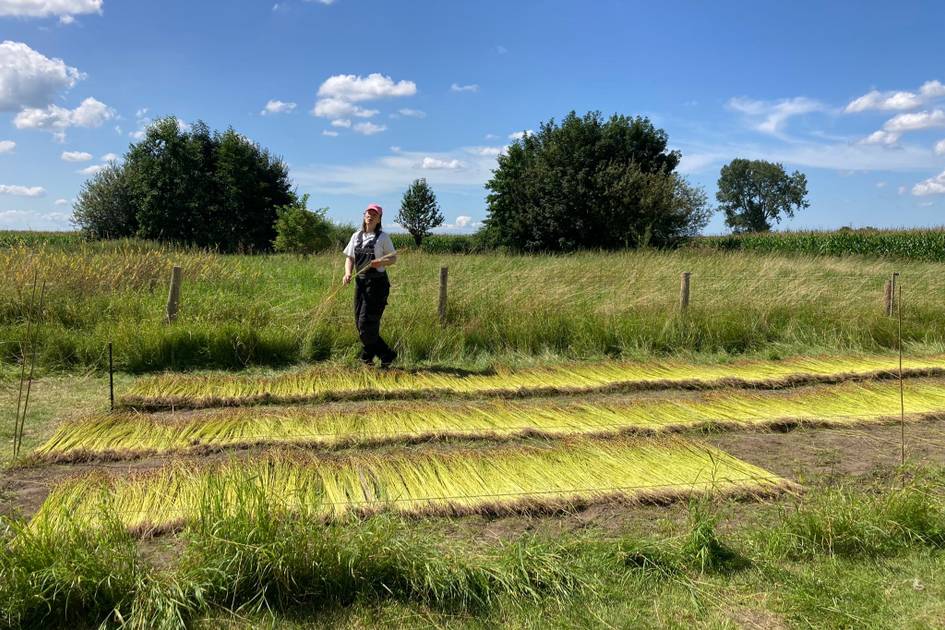
The first edition, introduced in 2023 as an ode to local linen, craftsmanship and timeless design, quickly found its way to women who wanted to wear a story, not just buy a jacket. The jacket sold out. I do, however, allow a well-thought-out design to return. Lin therefore returned in spring 2026. It was again a limited edition, again rooted in the same recognisable signature, but this time enriched with something that seemed almost impossible on paper: hand embroidery with flax thread from the very first flax harvest at our Fashion Farm in Welsum.
This gives Lin not just a reintroduction, but a deeper layer of meaning.
While the original design was already an ode to Dutch linen, this new version combines two sources in one jacket: the organically grown linen from The Linen Project and the first hand-spun flax thread from our own land, carefully incorporated into subtle embroidery on the shoulders.
Text continues after the image.
That addition makes the design precious. Not just because of the material, but because of the time involved. We first sowed flax at the Fashion Farm in 2024. Since then, the land has taught us lessons in patience. After two years, we now have more than 10,000 metres of hand-spun thread from our own Welsum flax. This milestone was as hopeful as it was confronting. Although we have thread, we still have no running metres of fabric. 10,000 metres of thread is probably just enough for 1.5 metres of fabric, or one garment.
If all that labour were factored into the cost, Lin would become an almost priceless couture piece. That is precisely why this reintroduction also contains a conscious statement: it reveals how much value normally remains hidden in the creation of textiles.

Text continues after the image.

It starts with land and the fibre itself
For the embroidery of our hand-spun flax thread, we collaborated with Martine from Het Borduurburo, an embroidery designer with over 25 years of experience in specialist techniques. For Martine, this collaboration felt like a meeting between past and future. Having grown up on a farm with a father who had a great love for flax, she immediately recognised something essential in my approach: a return to the source. Her expertise lies in preserving and passing on embroidery techniques, craftsmanship and textile knowledge as a necessary link to the future.
That is precisely why this project was special to her. It was not just about fashion, but because it started with the land. With the fibre itself.
Technically, working with our flax thread required exceptional precision. The irregular hand-spun yarns made traditional processing almost impossible. Martine eventually found a solution in a goldwork embroidery technique, where precious yarn is not pulled through the fabric but is carefully laid on top and secured with a finer thread.
Text continues after the image.
It is a technique traditionally used for materials that were too valuable to waste. That exact feeling presented itself here again. Anyone who knows how much labour, attention and land goes into a single thread treats material in a fundamentally different way.
That realisation touches the core of what the Fashion Farm makes visible. This is not just about producing clothes, but about restoring relationships: between maker and material; between design and origin; between fashion and agriculture.
The Lin jacket shows that regenerative fashion is not solely about the end result, but also about the intermediate stages. It is about the question: how can we create value, even when a process is still underway?
In an industry accustomed to focusing on speed, scale and efficiency, this feels almost radical. Perfection is not forced here; instead, we work with what is already there. With the first thread. The first harvest. The first opportunity.
Thus, Lin becomes more than a garment. It becomes a design where agriculture, textile innovation and specialist craftsmanship converge. Or perhaps a jacket that shows the future of fashion is not only woven, but sometimes emerges, stitch by stitch, in the space in between.
Joline
PS: would you like to follow my journey from seed to garment and all the intermediate stages? Sign up for our newsletter.
This article was translated to English using an AI tool.
FashionUnited uses AI language tools to speed up translating (news) articles and proofread the translations to improve the end result. This saves our human journalists time they can spend doing research and writing original articles. Articles translated with the help of AI are checked and edited by a human desk editor prior to going online. If you have questions or comments about this process email us at [email protected]
View the original article here


