


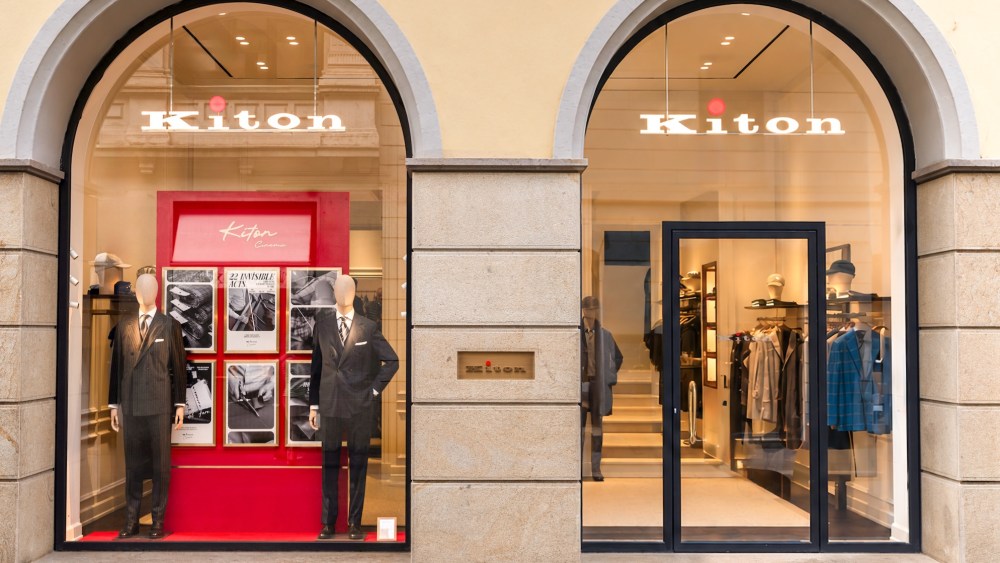

MILAN — Kiton may have just inaugurated a new flagship on Milan’s tony Via Montenapoleone, but with it, the Neapolitan tailoring brand has in fact secured an even more impressive retail footprint across the city.
The 2,700-square-foot space — positioned in a prime location between the Zegna and Brunello Cucinelli units which formerly housed Balmain — is entirely dedicated to menswear and reflects the continued importance of the line, which accounts for 80 percent of sales.
Its opening after six months of renovation also allowed Kiton to reimagine its previous flagship on neighboring Via Sant’Andrea, which is now devoted to the womenswear collections.
The retail trifecta is completed by Palazzo Kiton, the brand’s headquarters on Via Pontaccio in the arty Brera district, geared at trunk shows and one-on-one appointments reserved for key customers.
“Opening on Via Montenapoleone, one of the most important locations in the world, marks a new beginning for us,” said Antonio De Matteis, Kiton’s chief executive officer. “Milan is now one of the world’s leading centers of fashion and style. We wanted to strengthen our presence here by bringing to the city what has always set us apart: our culture of making, the value we place on relationships and the distinctly Neapolitan spirit of hospitality that is an essential part of our identity.”
The new Kiton menswear store on Milan’s Via Montenapoleone.

Courtesy of Kiton
“With this opening, we’re tripling our footprint in town… that’s a strategic vision that we plan to take to other cities in the world,” he said.
Conceived by architect Michele Bönan, the Via Montenapoleone boutique introduces a new retail blueprint for the brand, one inspired by Italian residences and living rooms, with warm parquet flooring, wood accents, molding and wainscoting and plush seats.
The store is anchored by a central staircase with a wrought-iron banister that ascends sinuously to the second floor, where Kiton is introducing a more intimate space dedicated to customization and made-to-measure. The private salon takes inspiration from the fabric vault at Kiton’s atelier in Arzano, Italy, with wooden cabinets displaying fabrics and an array of different tailored designs.

The new Kiton menswear store on Milan’s Via Montenapoleone.
Courtesy of Kiton
“We’ve started working with architect Bönan on a warmer, more home-like environment where customers feel welcomed and can experience the hospitality that’s part of our family’s DNA,” De Matteis said. “It’s the first in a series of projects designed to highlight the company’s family values… and get to know many of our end consumers personally. For example, I’ve spent time in the store over the past few days, and it’s been wonderful meeting many of them and hearing their perspective on our collections.”
Bönan is also overseeing the renovation of Kiton’s six-story townhouse and showroom on East 54th Street in New York, expected to be completed in 2027 to become a new flagship, flanking the existing unit on Madison Avenue. The building, known as the William H. Moore House, or Stokes-Moore Mansion, was erected between 1898 and 1900 as a private residence in the Renaissance Revival style. Kiton acquired it in 2001 and opened it in 2003.
The architect was also responsible for the light reconfiguration of the Via Sant’Andrea store, where new furniture and displays are intended to enhance the customer experience of Kiton’s female clients. Here the womenswear range — including jewelry, previously only available in the U.S. — has more room to be fully expressed, De Matteis said, highlighting the importance of the upper, more private, floor where changing rooms and intimate salons are located.

The Kiton womenswear store on Milan’s Via Sant’Andrea.
Courtesy of Kiton
“Womenswear has evolved over the years with a clear vision, progressively broadening its language while remaining true to our sartorial identity. The new boutique allows us to express every dimension of this journey,” said Maria Giovanna Paone, De Matteis’ cousin, president of Kiton and creative director of the line.
The latter has been growing steadily and currently represents about 20 percent of Kiton’s business.
“The women’s business is also performing beyond our expectations. We hope it will catch up with menswear and eventually account for half of our revenue, although menswear continues to grow, so the path won’t be linear,” De Matteis added.
Kiton currently has 64 stores in the world and reported sales of 230 million euros in 2025, up from 225 million euros in 2024.

Inside Palazzo Kiton in Milan.
Courtesy of Kiton
In the first six months of 2026, revenues were up 10 percent, De Matteis said, showcasing Kiton’s ability to deliver single-digit growth for the full year, driven by the U.S., its primary market, as well as Japan and South Korea. China and Europe are holding their positions and inching up modestly, the executive said.
De Matteis also touted the Middle East as a promising market, saying that while Dubai is struggling, Qatar and Saudi Arabia have been relatively unscathed thanks to the local clientele. He is hopeful business will improve across the region in November, with the start of the holiday season.
View the original article here


