



For centuries, the necktie has been a fundamental part of menswear. Its origins trace back to 17th-century France, when Croatian mercenaries, who wore scarves tied around their necks, inspired the French to adopt and enhance the style. This evolved into what is known as the cravat after it caught the attention of King Louis XIV. The cravat eventually became a fashionable accessory among the French elite and was often crafted from luxurious fabrics such as lace or silk.
Cravats were a precursor to the modern necktie, which emerged in the late 19th and early 20th century. Thanks to the Industrial Revolution, mass production of textiles made neckties more affordable and accessible. In the 1920s, Jesse Langsdorf, a New York tie maker, developed a new construction technique that involved sewing a tie in three segments, allowing for the creation of flatter ties.
Eventually, the necktie became a gold standard for business attire. However, by the second decade of the 21st century, neckties had become an endangered species. More relaxed office dress codes allowed men to wear suits and dress shirts while abandoning the formality of the necktie. The global Covid-19 pandemic turned sweatpants into work-from-home attire for a time. When society emerged from lockdown, “revenge dressing” reintroduced tailored pieces as people sought to dress up again, but neckties remained seen as relics of the past.
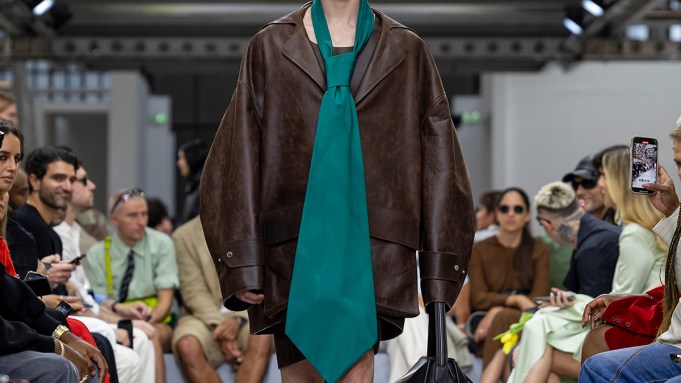
A model walks the runway at the Bottega Veneta fashion show in September 2024.
Vittorio Zunino Celotto/Getty
When the men’s spring 2025 collections were unveiled last summer and in September, the tie made a comeback, but not in an expected way. At Bottega Veneta’s spring 2025 runway show, the brand introduced a loose braided necktie paired with a classic office look. This was just the start of tie-mania.
Fashion influencer Legend Already Made, who has over 345,000 followers on Instagram, and has been incorporating avant-garde neckties and bowties into his looks since 2017, says that the unconventional necktie trend is timed perfectly to the rise in Black Dandyism. The 2025 Met Gala theme was “Superfine: Tailoring Black Style,” exploring the role of sartorial style in Black identities and the history of the Black Dandy. Much of Black dandyism involves taking elements of European menswear and infusing them with an African diasporic sensibility, including bright colors for suits, ties, pocket squares, and hats as a form of cultural expression.

Legend Already Made forayed into the world of men’s ties by working with famed London-based milliner Christine Campbell. He took a Gucci jacket he had to her because he wanted it cut up and made it into a top hat. Campbell got the brilliant idea to complement it with a bow tie, and this was how Legend’s penchant for avant-garde ties and bow ties was born. Eight years later, Legend says the popularity of the over-the-top ties is heavily influenced by streetwear.

Legend Already Made at an event in Miami in December 2024.
Daniel Zuchnik/Getty
“These fashion designers are seeing people like me on the street and other street style stars, and they are taking inspiration from street style,” Legend said. “Black Dandyism is this year’s Met Gala theme, and you know designers are paying attention to that aesthetic. The reason unconventional neckties are coming back in conjunction with the rise of Black Dandyism is that when you look at Black Dandyism, it’s both timeless and ahead of time. To dress as a Black dandy is to embody the past, present, and future in a single look, which you now see them putting on the runways. Black dandyism is both a quiet revolution, a loud statement, and an unshakable legacy. Black dandyism has been reinventing traditional fashion statements for decades, and now you see those companies following these trends for what Black dandyism has been the blueprint for.”
Legend is correct that designers have noticed the rise of dandyism and people’s desire for more individualistic looks. Dimitri Falk, the founder, creative director, and CEO of luxury custom suiting brand Vestium, is currently expanding his brand into ties. His brand is known for its statement suits, often made from unique materials like liquid velvet and upcycled corduroy. Rather than going for conventional boardroom-style ties, Falk is looking at creating ties from materials like lace, pearls, and leather.
“What I’m looking at for my ties is truly novel materials that we’ve been exploring with a Spain-based company that uses natural fibers, ranging from recycled cotton to silk,” Falk said. “Vestium already works with some of the best supply mills in the world and with some of the best possible materials. Regarding this trend in unconventional ties, when mixed with the right outfit, they can take a stodgy look and give it a whole new dimension.”
He added, “With unconventional ties, it’s taking a classic silhouette and reimaging it with prints and patterns. It’s something that could go from the business meeting to the café or a night out.”
Falk attributes the surge in the unconventional tie trend to the “revenge dressing” trend that happened post-Covid-19 lockdown. “People want to get dressed up again, and have fun with it,” Falk said. “They want more options in terms of materials, and they are moving beyond the suit and tie aesthetic of the old days. They want the flexibility of that look that can go from the boardroom to a rock’n’roll dance club. It’s almost what I would refer to as a reverse punk movement. It’s counterintuitive in the sense that we are taking the most traditional menswear and amplifying it with different materials.”

Omar Apollo at the Oscars on March 2, 2025.
JC Olivera/Getty
In times of uncertainty, with shocking news headlines and a turbulent economy, people are also looking at fashion as a way to defy convention. Unconventional ties add more joy to men’s wardrobes, a belief strongly held by luxury designer Wangda Chen of his eponymous label Wàngda.
“People need pieces, like unconventional ties, to cheer them up,” Chen said. “Ties in different colors and different textures can give people happiness or create a look with a more relaxing mood.”
While Chen’s ready-to-wear has skewed heavily toward the quiet luxury aesthetic, for his spring collection, when he introduced ties, he went in a more maximalist direction. He designed a chunky gray tie embellished with crystals and a skinny plaid tie. He said he wanted to go in a more maximalist direction, and also, why unconventional ties are trending right now is because “People love the contrast. It creates an element of surprise. Think of it like this, it’s like ordering a cheesecake with an espresso. It’s two different things that complement and help each other out. You’ve got something classic with something sweet and surprising. In an era of a tough economy, unconventional ties bring humor and lighten the mood. Now’s the time for people to play around with dressing themselves up to find happiness in the world.”
Celebrity stylist Amanda Lim, who has worked with top talents, including Mark Eydelshteyn, Young Mazino, and Reece Feldman, said the resurgence in neckties was a trickle-down effect that began with the Fashion Month runways.

Drew Starkey at the Screen Actors Guild Awards on February 23, 2025.
Amy Sussman/Getty
“Thom Browne and Saint Laurent are two great examples of brands that helped usher in the return of the necktie,” she said. “Musicians played a part in this as well. BoyGenius and ASAP Rocky are two examples of early wearers.”
Rocky especially has been known to don unconventional ties with exceptionally bold patterns, ranging from Versace emblem patterns to bold stripes. Lim says that brands like Valentino, who have done scarf ties, have also “Brought forth a certain softness to a traditionally masculine accessory that is really beautiful.”
When it comes to her client roster, Lim has clients who love exploring trends and leaning more avant-garde, and others who prefer to remain more traditional. Despite the current popularity of unconventional ties, she feels it’s just a trend having its moment.
“Everything is a trend these days,” she said. “We’ll see ties back to their regularly scheduled programming eventually. At the same time, red carpet styling has contributed to the broad range of ties and neckwear we’re seeing with this trend. Men are becoming much more bold and versatile, and it’s exciting to see. We hope this is reflected culturally as well.”
Lim added, “We think of trends like a pendulum. We saw David Bowie wearing ties in a fashion way decades ago, and now they have returned. Like most trends, neckties will likely come back around in another fun and unique way. Maybe next time, we’ll wear them as belts like Fred Astaire.”
The necktie has found new life for now, and gone is the era of it just being office attire. They are back, bold, and larger than life in many ways.
View the original article here


