



Courtesy of Adam Neeley
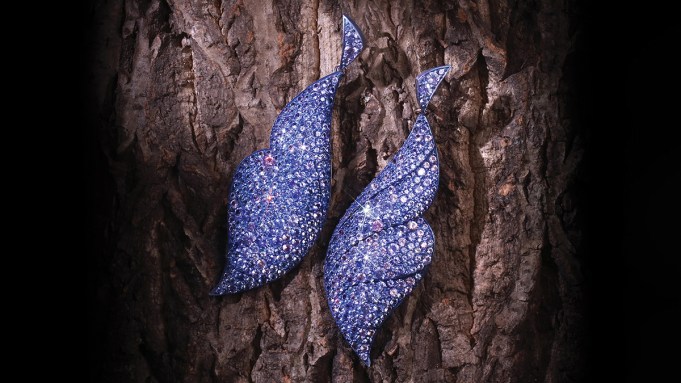
After a dinner party inspired by Salvador Dalí and his wife, Gala, Laguna Beach–based jeweler Adam Neeley dreamed the artist was wandering through his garden as a blue butterfly fluttered nearby. “This is actually the very first piece that I saw, or the first visitor, I would say, was this beautiful blue butterfly just shimmering on the tree,” Neeley says. “I started to see jewels in the pieces, and that kind of gave me the moment to wake up, and so I sketched it down.” Periodically falling back to sleep, he returned to the garden four more times, designing the initial collection in a single evening.
These one-of-a-kind earrings were the first jewels he imagined. As a genuine artisan, he touches nearly every phase of the production. “I came at [the craft] from learning all the different processes—starting with gemstone cutting, as a kid—so I really enjoyed learning every single part of the jewelry-making process,” he notes. He selected the 542 sapphires by painstakingly sorting through over 3,000 stones, arranging shades of blues, lilacs, and lavenders across titanium and white gold nearly the size of a real morpho butterfly’s wings.
Dalí—also known to dabble in jewelry—would no doubt be proud to know his Surrealist vision landed decades later with such a creative kindred spirit.
1. Formal Drawing

Image Credit: Courtesy of Adam Neeley After his initial dead-of-night sketches, Neeley begins work on the formal drawing. “It is to scale, and it is a manufacture sketch,” he says. A proper draft can take him three to four hours.

2. Stone Measuring
Image Credit: Courtesy of Adam Neeley Stones are then laid out on the to-scale sketch. A leverage gauge (top left) is used to measure the stones in millimeters. Neeley places all the stones individually to see how they fit together to achieve the perfect arrangement. “This is kind of like a puzzle…. These are all mixed sizes, which makes it feel more full and more visually interesting,” he explains.
3. Silver Prototype
Image Credit: Courtesy of Adam Neeley During the CAD process, a silver prototype is built to help precisely engineer the setting, balance, and articulation before it is created in titanium. “We learned to do this early on, because the titanium parts are rather expensive to produce,” he notes. “If we have an issue in titanium, there’s very little we can do to manipulate it.”
4. Solidification
Image Credit: Courtesy of Adam Neeley A laser beam hits a bed of grade-23 titanium powder (left) 3-D-printed at 20 microns—finer than a human hair—to form a solid part. The pieces are grown on a platform (similar to the one pictured, right). Neeley partners with companies in Belgium and the U.S., which typically work with NASA and other aerospace firms, for the process.
5. Alloy Melting
Image Credit: Courtesy of Adam Neeley Neeley melts a special alloy of white gold before it is poured to fabricate the back of the earrings. “After I do some of these major melting projects, I come out and I look like I’ve been staring at the sun because of how much heat is there,” Neeley says with a laugh. “I will say, I’ve had my moments of spilling gold on the floor…. I have around me a bunch of fire extinguishers that you don’t see in that photo, because we’ve had to use them.”
6. Skin Removal
Image Credit: Courtesy of Adam Neeley The printing process leaves a skin that is removed with diamond-tipped tools during the polishing stage. Of the 350 hours it takes to make the earrings, at least 100 are devoted to this sanding technique.
7. Stone Setting
Image Credit: Courtesy of Adam Neeley A setter places the stones into the pavé layout. Three small beads per stone get pushed over the sapphire to hold them in place. According to Neeley, only diamonds, rubies, or sapphires can be placed directly into titanium, due to the amount of pressure used to push the small titanium beads over the gems.
8. Voltage Testing
Image Credit: Courtesy of Adam Neeley To get the color as close to a morpho butterfly’s as possible, Neeley tests voltages on a titanium strip to match the blue morpho’s iridescent hue. The color changes with each modification in voltage, allowing Neeley to precisely dial in the desired color. The set earrings are then anodized at the chosen shade.
9. Final Application
Image Credit: Courtesy of Adam Neeley At the end, the white-gold backing is applied. Neeley uses 14-karat gold, because it’s lighter both in weight and tone. An Irish blessing about a butterfly is laser-engraved on the back. “This is the only piece in the collection that has this kind of message on it,” Neeley says. “I want to pay homage to the fact that this butterfly is what started it all.”




View the original article here


