


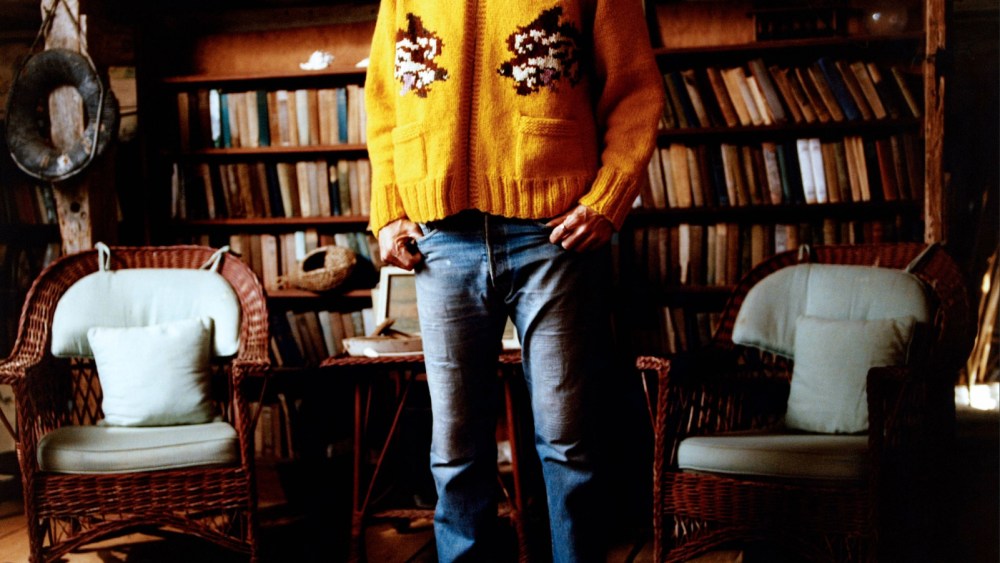

Grant Simm has spent years helping build some of the most popular brands in contemporary menswear. Now it’s his turn.
On Tuesday, Simm, who served as chief financial officer of Aimé Leon Dore and Rowing Blazers, will launch his own luxury brand, Badinage. The concept is small-scale product created by artisans from around the world. The launch will feature 11 sweaters — five cardigans and six crewnecks — hand-knit in India. Custom options will also be available with lead times of 30 to 90 days, depending upon the request.
In addition, Simm is working with two craftsman who are creating belts and knives that will be featured on the site and made-to-order.
“My experience with Aimé and Rowing Blazers was incredible, but it wasn’t my journey,” he said. “They are someone else’s brands.” So after pondering the possibilities for more than a decade, “now felt like a good time to scratch my creative itch.”
Simm knows there are a lot of sweaters in the market already, but what sets Badinage apart is its focus on craftsmanship.
“I wanted to create better product,” he said. “I’m really into vintage and antiques and I believe that it’s more about the story you create, not just the clothes.”
So in this time when speed and technology are front and center, Simm is taking the opposite approach. While the collection will be offered online, he said there will be no click-to-buy button. Instead, interested customers will send an email that Simm or his wife will answer before an order is accepted.

In fact, Badinage means witty chitchat or banter and was selected as the company name for the same reason.
“We want to create a relationship with the customer,” he said. “Everything is handmade and hand-knit and the pieces are something you’ll keep and wear for the next 20 years and then pass on to your kids.”
This unique selling technique also gives them the chance to explain the intricacies of the fabrics and the specialized, traditional techniques used to create each piece. Case in point: the yarn used for the sweaters is a blend of cashmere, silk and brushtail possum, a nocturnal marsupial from Australia and New Zealand whose hair is hollow. The strands trap air, which acts as an insulator, and they’re also light. Simm said it took him one-and-a-half years to create the yarn that resulted in sweaters that look heavy but are actually lightweight and not scratchy.
Because they’re handmade, each piece is slightly different, which adds to their allure, he believes. “There’s character and imperfections,” Simm said.
The time and effort put into each piece means the prices are high. The crewnecks retail for $1,750 and the cardigans for $2,250, with custom options even more expensive.
Each Badinage sweater is hand-knit in India.
Courtesy
But it’s not just the sweaters that are unique. The belts offered on the Badinage site are from Artemis Quibble, a New York-based atelier from husband-and-wife team Jason Ross and Natasha Chekoudjian, who work with many leading designers and luxury brands. The belts for Badinage are hand-painted and feature hand-forged buckles. They retail for $625.
And the knives are created by Mae Knives of Oceanside, Calif., which has become known for its chef’s knives. Owner DJ Brelje makes each piece from scratch, shaping the blade and faux ivory handle, which is then passed along to Andrew the Kid, a tattoo artist from Hideaway Workshop, who carves traditional coastal scenes onto the knives. They retail for $1,250 and can also be customized.
Like the sweaters, the belts and knives are intended to be used for decades, Simm said.
Badinage is completely self-funded, another indication of Simm’s dedication to the project. “It’s all on the line,” he said. “But I’ve been thinking about this for 13 years and I feel the world and the consumer is ready for it.”
Rowing Blazers did not respond to requests for its plans for a successor to Simm.
View the original article here


