


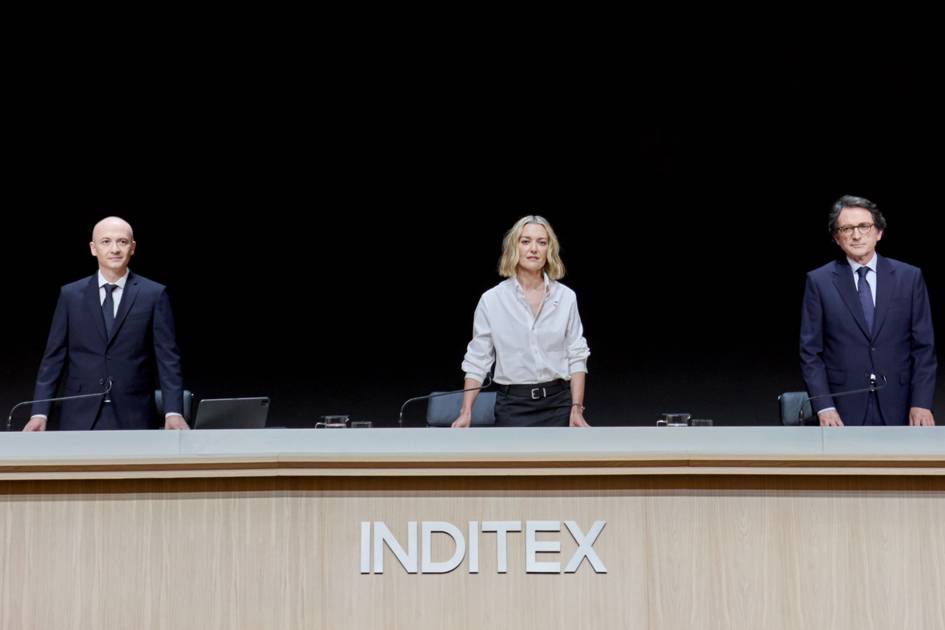

Madrid – Looking beyond the institutional message with which a particularly presidential Marta Ortega opened Inditex’s 2026 Annual General Meeting (AGM), we now delve into the significant issues raised before the Spanish group’s investors. During the meeting, as was widely expected, all items on the agenda were approved in their entirety. The ordinary meeting surprisingly saw Inditex’s own shop assistants from Galicia take the floor.
The ultimate goal of Inditex’s 2026 AGM was to submit the nine points on its agenda to a vote and analysis by its investors. Following an eloquent welcome speech by Marta Ortega, non-executive chairwoman of the board of directors, Javier Monteoliva Díaz took the floor. In his capacity as non-director general secretary of the Inditex board, he addressed the procedural matters required by law and the company’s statutes for such meetings. The event was held on Tuesday, July 7, at Inditex’s headquarters in Arteixo, A Coruña. Díaz then gave the floor to Óscar García Maceiras, the group’s chief executive officer since November 2021.
Maceiras thus directed his fifth Inditex AGM, the same number that Amancio Ortega’s daughter has opened and supervised as chairwoman of the board. He dedicated his address to investors to highlighting Inditex’s outstanding evolution over its first 25 years as a listed company, a milestone celebrated in 2026. This anniversary follows the 50th anniversary of Zara’s founding, which was celebrated last year in 2025. Maceiras noted that this success is underpinned by a “management style marked by high standards and a desire for permanent improvement” that has always prevailed within the company.
He completed his presentation with a general overview of the positive results for the 2025 financial year. He emphasised the main indicators to shareholders, who were to vote on the approval of the 2025 accounts and reports during the meeting, held as scheduled on the first call. Maceiras stressed that these positive results, achieved in a complex environment, were due to the strong commercial performance of the group’s brands and efficient operational management by its teams.
“Our purpose remains the same” as it was when the company went public 25 years ago: “to reach millions and millions of people around the world every day,” Maceiras told Inditex shareholders. He added that the goal is to do so “with an increasingly attractive fashion proposition and an ever-improving experience for our customers.” “This purpose has guided us in 2025 to continue on a path of positive growth, despite a complex geopolitical and macroeconomic environment.” This path has been possible thanks to “good commercial performance” and “efficient operational management.” “Why are these figures important?” the Inditex CEO asked shareholders. “Because they demonstrate the financial strength and solidity of our business model, the main guarantees that we will continue to invest whatever is necessary for the group’s future sustainable growth.”
Inditex’s 10 pillars for future growth
Following these words of confidence to investors, which were backed by various investment plans the company has implemented in recent years, Maceiras guaranteed a sustained commitment to investing in the company’s “future.” This includes an exceptional plan to strengthen logistics capabilities with 900 million euros annually for 2024 and 2025, completed last year alongside ordinary annual investments of 1.8 billion euros. He highlighted the ordinary investments of around 2.3 billion euros committed for 2026. These funds will be used to reinforce and advance each of the 10 growth pillars on which Maceiras bases Inditex’s immediate future. These pillars encompass various initiatives the company will continue to launch. They aim to advance its growth, customer experience, adoption of new technologies, product design and quality, “emotion,” innovation, efficiency, talent, its commitment to Spain, and its position as a company committed to communities worldwide.
Looking ahead to 2026 and beyond, “we maintain our purpose” of “offering attractive fashion, based on design, quality and produced responsibly,” as well as “the best possible experience for our customers,” Maceiras told Inditex shareholders. In this purpose, “we are ambitious,” and “we will continue to grow, we will continue to innovate, we will become increasingly efficient, and we will have an ever-greater positive impact.” All this will be done while the company and its various portfolio brands remain true to “a strategy of stable and accessible prices for the largest possible number of people.”

1.- Growth and expansion
Briefly elaborating on each pillar, Maceiras reiterated that in terms of growth and expansion, the group’s eight chains—Zara, Zara Home, Pull&Bear, Massimo Dutti, Bershka, Stradivarius, Oysho and Lefties—will continue to pursue differentiation strategies. These strategies will allow them to expand their presence in existing markets and enter new regions and countries. He highlighted developments already announced in late 2025 and the first half of 2026. These include the opening of the first Bershka stores in the US and Brazil; the planned arrival of Lefties in France, the UK, and now officially confirmed, Germany; Pull&Bear and Massimo Dutti in Denmark; and Zara Home in Norway.
With these and other strategies to be implemented, “our eight commercial formats continue to increase their differentiation, attract new customers and strengthen the bond we have with our current customers,” Maceiras said during his speech. For Zara, “the group’s engine,” Inditex will “continue to increase the chain’s retail space” and “will continue to improve our stores with image, technology and in new locations, executing projects in major cities around the world.” Meanwhile, “thanks to our international presence and the experience we have acquired over time, the rest of our commercial formats will continue to execute ambitious growth plans.” He concluded, “we continue to see opportunities for expansion; opportunities that we will seize by following our guiding principle of profitable and selective growth, project by project.”
2.- Customer experience
In response to the growing trend and paradigm shift towards customer experience, the company will continue to promote initiatives aimed at meeting the needs of “increasingly demanding and experience-oriented customers.” This will be achieved through “new services and new functionalities,” as well as the “execution of projects that generate community.” Examples of these initiatives include Zara’s “Try-On” virtual fitting room, which Maceiras announced in March will be rolled out to the group’s other chains. Other examples are the Bershka MMBRS loyalty club, which currently has over 40 million users in 18 markets, and Oysho Community, which provides access to exclusive sports events and launched a “pro” version for professionals at the end of May.
3.- Latest technologies
As the third pillar, Maceiras presented Inditex’s constant commitment to the latest technologies. The Spanish company will focus on innovations that streamline the purchasing process and eliminate friction points. A recent example is a new labelling system introduced in early June. This system allows visually impaired customers to access all product information autonomously via their mobile phones. Maceiras noted that this initiative will be rolled out across all the group’s brands and in all markets where they operate.
4.- Design and quality
Contrary to claims made on social media by supposed fashion and business analysts, Inditex is first and foremost a fashion company focused on selling clothes. The multinational directs all its efforts, investments, and strategies towards this purpose. This naturally includes a firm commitment to the design and quality of its product offering. The group’s CEO highlighted that the company will “continue to listen to our customers.” It will place the talent of “our more than 700 designers” and the staff of “our pattern-making teams” at their service and at the service of the fashion they demand. The company is also working towards quality fashion with a lower environmental impact. These commitments are being pursued in collaboration with suppliers, research centres, and specialised laboratories “for the analysis and improvement of our products.”
5.- Emotion
The term “emotion,” the desire to “excite,” is becoming a cornerstone of the strategies of major fashion houses and groups, including Inditex. Marta Ortega used the term three times during her welcome message to shareholders. Maceiras confirmed this commitment to the “emotional” by placing it among the main pillars for building Inditex’s future. The company aims to continue “exciting” and “surprising” fashion consumers, primarily through new collaboration strategies with relevant figures from the worlds of art, fashion, and culture. At the same time, the CEO of the Spanish company stressed that Inditex remains true to its unwavering principle of offering quality fashion at accessible prices.
“In order to continue exciting and surprising our customers, we will continue to develop projects in collaboration with figures from the world of art and culture.” These alliances, Maceiras noted, “are allowing us to reach an audience and acquire a relevance” as a company “that is unprecedented in the history of our group.” “So far in 2026 alone, we have collaborated with figures such as Willy Chavarria, Aaron Levine and Bad Bunny. Also in March 2026, we announced our collaboration agreement with John Galliano, the first fruit of which will be a collection that we will launch from September, with a timeless fashion proposal.” He added, “logically, all our efforts in relation to design, quality, durability” and “the future collaborations that we will continue to make available to our customers, will remain compatible with a strategy of stable and accessible prices for the largest possible number of people.”
6.- Innovation
Complementing the strategies for implementing new technologies, but as a distinct pillar, is a sustained commitment to innovation. Inditex will use this to shape its future, both physically and digitally. This area includes the adoption of new solutions driven by artificial intelligence, everything related to its online platforms, and innovations in the strategic field of logistics. The latter will be pursued mainly through robotisation and automation projects to improve productivity and competitiveness. These projects are based on the implementation of RFID technology, which is revolutionising Inditex’s logistics architecture. They also rely on the adoption of the new “invisible alarm” system, already implemented in over 90 percent of its products. This system “is allowing us to provide our stores with a new technological ecosystem that is radically transforming our processes and operations,” through examples like self-checkout tills or automated processes “that connect our fitting room areas with our warehouses.”
Within Inditex, “innovation is not the result of isolated projects, but the logical consequence of a systematic and permanent process of searching for, analysing and implementing new solutions,” said Óscar García Maceiras. From this perspective, “we will continue to innovate, as we have always done at Inditex,” seeking to “take advantage of any technology at our disposal, but without losing sight of the importance of the human component, as our chairwoman pointed out in her opening speech.”
7.- Efficiency
Advancing efficiency, through better use of resources and raw materials, was also presented as one of the 10 pillars for Inditex’s future. The company is shaping this future hand in hand with its suppliers. Together, they are implementing transformation plans to reduce the impact of water and energy use in their facilities. This contributes to a company based on a less polluting and more efficient model, from garment manufacturing to logistics processes, which includes incorporating renewed fleets for which “we are promoting the use of sustainable fuels.”
“We are going to be increasingly efficient,” Maceiras proclaimed to Inditex shareholders. “In a sector like ours, which uses a large number of suppliers and has processes divided across different markets, achieving the levels of efficiency we aspire to requires working in collaboration with our supply chain.” This is already being done “together with our suppliers,” with whom “we are executing a transformation plan that currently has specific action plans for almost 1,000 facilities.” These initiatives will allow Inditex to have “an ever-increasing positive impact” on the environment and on people.
8.- Talent
Continuing with the assertion of people’s value as the true engine for Inditex’s future growth, as championed by Marta Ortega in her speech, Maceiras also highlighted the talent of Inditex’s people as a strategic pillar for its future. He called on the more than 160,000 employees from 174 countries that the company employs globally to continue contributing to this future. The Spanish group will support these professionals through training and development plans in new tools, technologies, leadership, and team management; prioritising internal promotion; and improving their working and economic conditions. In this commitment, he highlighted both the agreement for the upward renewal of salaries for its store staff in Spain and the decision taken by the company, together with its workers’ representatives, to start exporting the “extraordinary incentive for commercial performance”—more popularly known as the “shop assistants’ bonus”—with which it rewards its shop assistants in Spain, to the other markets in which Inditex operates.
9.- Commitment to Spain
Spain, the company’s country of origin and headquarters, will continue to hold a preferential position within its structures, dynamics, and investment strategies. This “commitment” to the country, Inditex’s largest market by turnover and where it employs some 50,000 workers, nearly a third of its global workforce, will materialise in new investments. These will be in stores, logistics, and corporate headquarters, including the construction of the new Inditex Campus in Barcelona for the new central offices of Massimo Dutti, Bershka, Oysho, and Lefties.
“We will continue to contribute to the economic growth of our country,” Maceiras asserted to Inditex shareholders. “We were born in Spain. Spain continues to be our number one market,” and “in Spain we will continue to invest; in our stores, in our logistics platforms, in our corporate headquarters, such as the future Inditex Campus in Sant Adrià de Besos.” He also mentioned “deploying new projects in very different areas, including technology, which will contribute to strengthening the business fabric and generating new opportunities for economic growth.”
10.- Support for the “community”
As the final point of his strategies, Maceiras highlighted the growing commitment the company will continue to make to communities in different regions of the world. These commitments have materialised in recent weeks with a donation of 3 million euros to benefit those affected by the earthquakes in Venezuela. Another commitment is the renewal of the alliance with UNHCR, under which Inditex will allocate 13 million euros between 2026 and 2028 to improve the living conditions of Rohingya refugees in Bangladesh. In addition, the company will donate another 7.5 million items of clothing and footwear over the next three years to refugees in countries such as Uganda and Chad. This donation will incur an additional logistics cost of around 2 million euros, which Inditex will cover.
Marta Ortega, a “differentiating” value for Inditex’s strength
Concluding this part of his speech, Maceiras continued his address to shareholders by calling for their support for Inditex’s future. This new stage will continue to be marked by its origins and fundamental objectives. He praised the positive influence and “differentiating strength” provided by both Amancio Ortega, as founder, majority shareholder, and key figure on its board of directors, and the rest of the founding family members, especially Marta Ortega, in her position as chairwoman of the board. Maceiras thus acknowledged her more than positive and active role in the group’s recent results and performance.
“Maintaining our purpose of offering fashion based on design, quality, produced responsibly, and the best possible experience for our customers,” the desire to “continue to grow, continue to innovate, become increasingly efficient” and “have an ever-greater positive impact,” are “tasks that will only be possible thanks to the trust of our shareholders,” Maceiras explained to Inditex investors. “Many of you have been with us for the last 25 years, almost half of our company’s life. Our company has an additional factor, a differentiating strength, which is the presence of the founding family in the shareholding and in the chairmanship of the board of directors, supporting our management and providing vision, commitment, continuity and stability every day.”
Regarding this reality and “differentiating strength,” which is personified today in the figure of Marta Ortega, he said, “I invite all of you to continue to accompany us on the road ahead. A road that will undoubtedly be full of challenges and opportunities. Challenges that we will be able to overcome, and opportunities that we will continue to seize as we have always done at Inditex, with humility, with prudence, but also with ambition.”
Inditex’s shop assistants take the floor
In an equally noteworthy event, during the final part of the meeting, in the interventions section, Lucía Domínguez Rodríguez managed to take the floor. She is a delegate of the Confederación Intersindical Galega (CIG) and president of the Stradivarius works council in A Coruña. She spoke on behalf of all the store workers of the different Inditex chains in Galicia. A representation of these workers was stationed at the gates of the Inditex headquarters in Arteixo, where the meeting was being held, to protest against the state agreement for large chains promoted by the Asociación Retail Textil España. They condemn this new labour framework, which they say is specially promoted by Inditex, and which will lead to a marked impoverishment of working conditions for workers in regions such as Galicia.
After managing to “circumvent” the control measures for participation in the AGM by buying a share in Inditex, Domínguez began her speech “on behalf of the majority of the workers in Inditex’s stores in Galicia.” She made her intentions clear: “to request very relevant information for our group on remuneration and working conditions.” “Today, accounts, reports and remuneration will be approved here, with figures whose magnitude is difficult for us shop assistants, who are the visible face of the company every day with effort and enthusiasm, to comprehend.” “We are the ones who sell the product” that “allows the company’s profits,” and while “we are very happy and proud that once again we can talk about great results and great remuneration,” she added, “for years, we shop assistants have fought to improve working conditions.”
In that battle, “it was not until 2023 that we achieved a substantial improvement that has brought us closer to the salaries and improvements that the rest of the company’s staff had had for a long time.” However, “subsequently, Inditex created an employers’ association of large textile retail companies,” Arte, “with the aim of creating a state collective agreement that is about to be published.” This agreement, if not remedied, will lead to “losses” in wages and working conditions of up to “2,000 euros per year for the largest category in the sector in the province of A Coruña, which is the shop assistants.” Faced with this impoverishment, which would initially affect new workers in particular, “we have formally approached Inditex on several previous occasions, demanding a written solution that guarantees that these unjustifiable and totally unnecessary setbacks do not occur.” However, “the response has been silence, or vague promises, which do not provide any formal guarantee” against this setback.
The agreed salary improvement mentioned by Maceiras is no relief either. In the “best case scenario,” it would not be a +4 percent increase but +1.65 percent per year for provinces like A Coruña or Pontevedra; an increase that “does not correspond to the company’s current performance.” In light of all this, Domínguez concluded her speech by demanding an answer from Inditex. She asked if the company would agree to offer “a legal and juridical guarantee, in writing, that these setbacks in salaries and other conditions will not occur, neither for current staff nor for those who join in the future.” She also asked them to sit down and negotiate “an improvement that would effectively make possible the announced +4 percent increase for 2026” for all its workers.
In response to her intervention and demands, García Maceiras replied, “thanking you first of all for your attendance at this Annual General Meeting, and for your contribution to the group’s development.” He continued, “I would like to begin by pointing out that, as the chairwoman pointed out in her opening speech, and I also did during my speech, the success of Inditex, the success of this company, is only possible thanks to the commitment, effort and talent of the thousands of people who work with us every day, in our stores, in our logistics, in our offices” or “in our factories.” “And precisely for this reason, our priority from the outset has been to offer employment conditions that are competitive, stable and of high quality, resulting from permanent dialogue with the legal representation of our professionals.”
“In this context, we consider that the recent signing of the first state collective agreement for the large textile retail chains in Spain is very good news for the sector, because it helps to raise the level of protection and working conditions of the large distribution companies in Spain.” However, apart from “that agreement, Inditex’s store staff enjoy conditions that are far superior to those of any collective agreement,” especially after having “renewed the state store agreement.” From this point on, and in a more direct response to the shop assistants’ demands, he limited himself to pointing out that “our agreements remain fully in force.” He added that “we will continue to work on their evolution, through dialogue and collaboration, with the aim of continuing to recognise that commitment, that effort,” and “the talent of our professionals, which will undoubtedly continue to be an essential driver of our group’s future growth.”
- During Inditex’s 2026 Annual General Meeting, its CEO presented its 10 strategic pillars for future growth, mentioning global expansion, improving the customer experience and adopting advanced technologies.
- The company will reaffirm its commitment to design, quality and “emotion” in fashion, highlighting its collaborations with figures such as John Galliano and Bad Bunny.
- Inditex’s shop assistants in Galicia managed to speak at the shareholders’ meeting, expressing their concern about the new Arte collective agreement, which they claim will worsen working conditions; the company responded to these fears by highlighting its commitment to offering its workers conditions above those stipulated in any agreement.
This article was translated to English using an AI tool.
FashionUnited uses AI language tools to speed up translating (news) articles and proofread the translations to improve the end result. This saves our human journalists time they can spend doing research and writing original articles. Articles translated with the help of AI are checked and edited by a human desk editor prior to going online. If you have questions or comments about this process email us at [email protected]
View the original article here


