


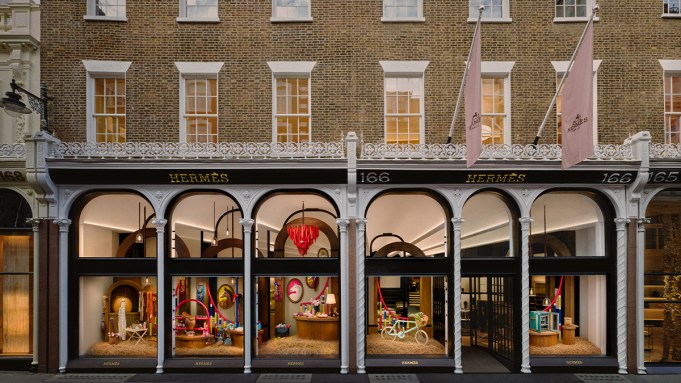

“Much anticipated” is a phrase routinely applied to any opening on New Bond Street: a thoroughfare mentioned in the same breath as Avenue Montaigne, Via Montenapoleone, and Fifth Avenue, and home to flagship stores from major luxury houses including Chanel, Louis Vuitton, Cartier, and Bulgari. But the unveiling of Hermès’s new London maison at number 166 is a particularly significant milestone in the narrative of a street that has evolved from a fashionable residential address into Britain’s premier luxury shopping destination.
Occupying six Grade II listed, interlinked Georgian townhouses that were home to Asprey from 1847 until Hermès purchased the property for 75 million pounds in 2009, the space has now proved an exceptional platform to showcase the maison’s craftsmanship, creativity, and architectural ambition. Paris-based architecture studio RDAI, led by artistic director Denis Montel—a longtime Hermès collaborator responsible for hundreds of the brand’s boutiques worldwide—is behind an interior aesthetic which seeks out a distinctly British expression of the Hermès universe (“My grandfather believed that Hermès is the most British of French houses,” as Hermès’ artistic director Pierre-Alexis Dumas has commented).
The space is home to 500 artworks.
Valerie Sadoun
First-time visitors can expect a labyrinthine world—55 rooms, taking up over 21,00 square feet in all over five floors—connected by three lifts and four staircases, the most dramatic of which is a spiral masterpiece originally designed by Foster + Partners and extended as part of the renovation. Throughout the store, more than 50 artisans contributed elements from handcrafted furnishings and decorative wall treatments to specialist glasswork and marquetry. The space is graced with 500 artworks, selected specifically for this address by Dumas. Every Hermès métier, meanwhile, is all present and correct: from leather goods and silk scarves to jewelry, watches, homeware, and ready-to-wear.
Hermès’s new home has been led by two intentions, says Dumas. The first is to pay homage to British culture, which had a large influence on the house in the 19th century, “as a reference for the elegance and craftsmanship of equestrian tradition. The nod really was then, and is, British know-how and culture.” The second, which Dumas adds was the most challenging, “was to bring a little bit of Hermès soul into the space.” That has been impressively done here with a respect for craftsmanship and history, whether restored mosaics discovered during construction or featuring circa 19th-century street signage throughout (cue a delightfully whimsical one selling late 18th-century bicycles).


The most challenging aspect “was to bring a little bit of Hermès soul into the space,” Dumas says.
Valerie Sadoun
All this adds to that signature Hermès sense of lightness and joy, in what otherwise would be a staid and heavy, storied luxury house. As Hermès CEO Axel Dumas, who was also on hand to inaugurate the new flagship, says: “We tried to work mostly from intuition, desire, and not a strategy . . . We are not a marketing company so we try to do what is right,” he says. “Pierre-Alexis and I are the sixth-generation and we bought this for the seventh generation.”
View the original article here


