



French jewelry maison Boucheron was founded in 1858 and built a legacy of adorning royals, stars and magnates in jewelry that combines precious, rare gems with equally ingenious designs. Though it was the first jeweler to set up shop on Place Vendôme, the epicenter of Parisian high jewelry savoir-faire, it is the new kid on the block in the US, having opened a North American flagship on Madison Avenue in New York City just two years ago. Nearby, a newly opened ten-day exhibition (October 9-18), Boucheron: In Focus, a Monograph of a Visionary, in collaboration with auction house Christie’s, is poised to better acquaint local clients (and the merely jewelry curious) with its extensive, impressive heritage. “We have to tell our story,” said Boucheron CEO Hélène Poulit-Duquesne about the purpose of the event. “And I would love people to come out of this exhibition understanding how deep our history is and the fact that we really have two threads: one is of historical craftsmanship spanning nearly 170 years, and the other is that we’re super innovative.”
Boucheron Question Mark necklaces
Boucheron
Within a series of midnight-dark rooms at Christie’s New York headquarters lies a sumptuous survey of exceptional Boucheron high jewelry through the ages, from the 19th-century origins under founder Frédéric Boucheron to a collection introduced earlier this year. Most items come from the maison’s archive, with a few loaned by private collectors. Ms. Poulit-Duquesne describes the array as “The height of the art. The top of the pyramid.” Pieces like a suite of jewels resembling primary-color Pop Art, or an emerald-paved “question mark” necklace (its patented mechanism had no clasp and allowed women to get into and out of their jewelry unassisted), bear that out.

Lady Harcourt’s 1924 Boucheron diamond tiara
Instead of a chronological tack, the exhibition is organized by themes that have prevailed throughout its history: architecture, nature, history, and innovation. Even in a show chock full of masterpieces, Ms. Poulit-Duquesne cites a few items that are not to be missed, including Lady Harcourt’s 1924 diamond tiara, a bandeau-style jewel featuring a mix of stylized leaves and scrolls and Mrs. Mackay’s necklace, a laurel wreath collar featuring seven cushion-cut rubies surrounded by old mine- and old European-cut diamonds, dating from 1888. The maison acquired the tiara at auction earlier this year for its archive. According to the CEO, both are from the Boucheron era most prized by collectors: “the period of Frédéric Boucheron—the end of the 19th century to the beginning of the 20th century.”


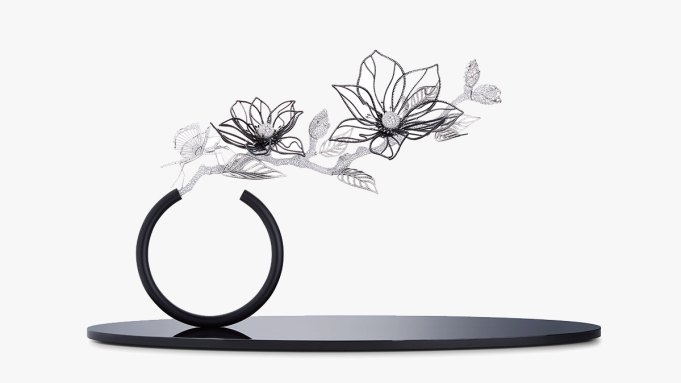
Boucheron Composition No. 3 is a sculpture that transforms into wearable jewels
Boucheron
Two recent high jewelry collections appear in individual, dedicated zones. Dubbed Impermanence and Human Nature, each represents some of the brand’s most innovative and technically experimental work, and both are among the few pieces still for sale. The former is a series of sculptural floral compositions in borosilicate glass, ceramic and diamonds that look encased in ice, frozen on the precipice of life’s end. The latter features five suites of jewels that repeat identical bib necklace and two-finger ring silhouettes, though each uses distinct materials and unique know-how. Creative director Claire Choisne has “total freedom” over these Carte Blanche high jewelry collections, according to Poulit-Duquesne. Their unorthodox materials and craft-intensive approach tend to attract a specific cadre of clients, she says—ones that “are more similar to contemporary art buyers. They come for creativity.”

Boucheron Checkers necklace and ring
Boucheron
As with any important Christie’s exhibition, an accompanying catalog makes for the ideal souvenir. Unless, of course, one can bring home one of the high jewelry pieces for good.
View the original article here


