


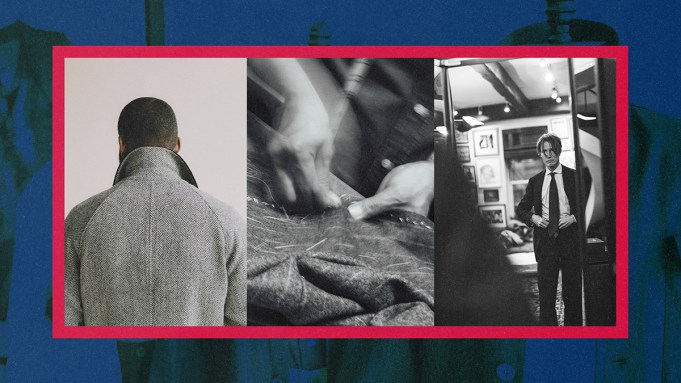

Courtesy of Taylors’ Keep; Factor’s; Jonas Sundstrom of J. Meuser: Milad Abedi; Fayad & Co: Pipe Yanguas
The United States has long been called the Land of Opportunity, but there was one field where it conspicuously lagged behind: custom tailoring. Those serious about going under the needle were more likely to do so during a business trip to London, a vacation to Southern Italy, or even a jaunt through Hong Kong than they were to visit a cutter closer to home.
But just a few years divorced from a world-wide pandemic that was supposed to put us in sweatpants forever, American tailors are on the up-and-up. Whether they practice the rarefied craft of bespoke, in which a unique paper pattern is cut for each client, the less cost-prohibitive made-to-measure business that tweaks an existing pattern, or something in between, the demand has never been higher.
“I think a lot of young guys just didn’t know about it, especially in the U.S.,” says Nate Pozin, cofounder of the recently launched New York maker Haitch. “They didn’t have their tailor or ‘their guy.’ But now we’re really seeing it expand.” We’ve scoured the land from sea to shining sea to find eight tailors worth your time—plus a refresh on London’s finest for those still wishing to cross the pond.
Top, from left: This clean-lined balmacaan from Factor’s in Atlanta has a velvet collar. Tailors’ Keep produces bespoke suits in its San Francisco atelier. Jonas Sundstrom, shop manager at J. Mueser in New York, examines the brand’s work in the mirror. Miami’s Fayad & Co. uses suiting fabrics for non-tailored garments.
Angel Ramos | New York City

Image Credit: Courtesy of Angel Ramos 
New York–based Angel Ramos doesn’t have a dedicated showroom but instead meets clients at trunk shows across the city (including a monthly iteration hosted at John Lobb’s Madison Avenue flagship). The louche house style is a close reflection of its swaggering founder’s personal look, which combines the softness and fluidity of 1930s Southern Italian tailoring with the effortless glamour of Golden Age Hollywood. Its made-to-order and made-to-measure jackets are marked by a high vent, soft shoulders, generous lapels, and a distinctive Milanese buttonhole, while trousers are cut high and wide for proper drape—which tracks with the powerfully built tailor’s past life as a Division I college athlete. Eveningwear is a particular focus for Ramos, who delights in fitting clients in the brand’s indulgent and best-selling ivory dinner jackets. “I treat eveningwear like I treat my Champagne,” says Ramos, a staunch advocate for trotting out tuxes on more than special occasions. “I don’t drink Champagne because it’s a celebratory drink. I drink Champagne because it’s wine.”
Above: Angel Ramos’s louche aesthetic comes to life in his eveningwear, which fuses fluid, comfortable cuts with bold fabrics.
Factor’s | Atlanta
Image Credit: Factor’s The traditional haberdasher is an endangered species, but it’s still a feature of Southern life. Factor’s founder Matt Lambert knows this all too well. He began his career at 77-year-old retailer Bernard’s in Jasper, Ala., before working for Sid Mashburn. But Lambert, who launched his business in 2020 and opened its brick-and-mortar in Atlanta’s Little Five Points neighborhood in 2023, wasn’t interested in being another trad clothier. His made-to-measure tailoring, produced in New York, has a modern bent: The jackets skip darts and instead use high vents to flatter the waist, and the trousers have Hollywood waistbands to create a slimmer silhouette. “I just got to the point in life where I had a voice that wasn’t being met, and it was time for me to come up with my own designs,” Lambert says. Though the aesthetic is different, Lambert still places Factor’s in the Southern-haberdashery tradition, which is based on hospitality: The shop hosts pool tournaments and music shows, and the front door is always open. “I wanted to create a spot that felt like a community center for the neighborhood and would hopefully get [guys] to buy some cool clothes along the way,” he adds.
Made-to-order suiting from $2,350; made-to-measure suiting from $3,100
Top, from left: The Factor’s store hosts regular pool tournaments and concerts. A model shows off the brand’s signature waistband.
Fayad & Co. | Miami
Image Credit: Pipe Yanguas “I’ve always been in the business of people,” says Fayad & Co. founder André Fayad. “I think making people happy is the business.” He has had an interesting journey on his way to running a Miami-based bespoke-tailoring operation, with a showroom of his own now open in Surfside. Born in Honduras to a family in the textile trade, Fayad studied the business of fashion in Milan before embarking on a career in high-end retail and later serving as the concierge at the Ritz-Carlton Bal Harbour. Fayad & Co. was launched in 2020 and soon gained acclaim for its locally made, bespoke guayaberas. But it’s his U.S.-made bespoke tailoring that accounts for the majority of the business. The customer-first entrepreneur eschews the idea of a house style, saying that he instead defers to customer expectations. One way he’ll surprise you? By employing suiting fabrics to make more-casual garments. For instance, utilizing high-end linen or wool fresco to make the house take on an M-65 jacket. His other key to success? An innate understanding of how different cloths perform in heat. “Based on the fact that I’m from Miami, I have a sensibility of what fabrics work in warm weather.”
Bespoke shirts from $470; bespoke suiting from $3,850
Above: At Miami’s Fayad & Co., extra attention is paid to the lightness of the fabrics on offer. Its founder, André Fayad, started his professional life in retail and hospitality.
Haitch | New York City
Image Credit: Paul Rudd: Photo by Robin Marchant/Getty Images/Lionsgate; Haitch Established in 2024 by former Thom Sweeney employees Harry Tillman and Nate Pozin, Haitch boldly departs from the soft silhouette that has dominated tailoring for the last decade-plus by making longer jackets with square, padded shoulders. Influenced by Tillman’s experience as a bespoke cutter and Pozin’s background as a musician, the aesthetic is powerful and spare. “It’s something that you can dress up to the max. But then you can also wear that same jacket with a pair of jeans and a T-shirt if you’re just going out at night,” Pozin says of the style’s surprising adaptability. With made-to-measure produced in Asia or Italy and bespoke made in Asia, Italy, or New York, Haitch offers a variety of price points to buy into its against-the-grain look. “[Guys] come in, try our stuff, and they are shocked by how comfortable it actually fits,” Pozin adds. Beyond tailoring, the business also offers outerwear ranging from overshirts to car coats.
Made-to-measure suiting from $2,800; bespoke suiting from $5,400
Above: Haitch, the youngest operation in this group, has already dressed a list of stylish guys such as Paul Rudd, Ethan Hawke, and SubwayTakes’ Kareem Rahma.
J. Mueser | New York City
Image Credit: Milad Abedi As the setting of its second-floor atelier (opposite the ground-level retail store) on Christopher Street suggests, J. Mueser caters to a younger, more downtown crowd. The affable Jake Mueser, who established the business in 2008, offers two makes: the softer and more lightly canvased Waverly, produced at a workshop in Naples, and the more built-up Mayfair, which is bench-made in New York with a higher degree of handwork. Each features house signatures including a soft shoulder, broad lapels, and a lowered buttoning stance. They can be made in custom-developed fabrics such as linen blends for summer and different weights of high-twist fabrics for year-round wear. Besides traditional tailoring, the label also produces casual outerwear that can be made from leather, suede, and technical fabrics. “It’s about blending great techniques from around the world, picking the things that we believe are the best aspects of tailoring, and bringing that all together under one cohesive look,” Mueser says. “That feels like the most quintessential New York thing you can do.”
Waverley suits from $2,950; Mayfair suits from $4,950
Above, from left: Jake Mueser measures client Drew Joiner for a new commission. Shirts are designed to look just as good with ties as they do without.
Ralph Fitzgerald | New York City
Image Credit: Fitzgerald Bespoke Ralph Fitzgerald has made quite a name for himself at just 32 years of age, with an eponymous bespoke business located on the Upper East Side and a clientele stacked with film and fashion A-listers including Paul Thomas Anderson and Marc Jacobs. The London-born founder entered the industry at just 16 and creates a contemporary take on the Savile Row suit—nipped waist, low buttoning point, and roped shoulders—but with lighter canvasing (the inner linings that give traditional suits their structure and drape) and padding. Fitzgerald, who cuts each suit and has them made between New York and London, relishes the hunt for vintage and one-off fabrics in order to bring the unique commissions of his clients (roughly half of whom are women) to life. “I really enjoy making bespoke garments that people have envisioned and can’t get in the stores—something that people have always craved,” he says.
Above: London-born Ralph Fitzgerald has been making clothing since he was 16. Now 32, he has a client roster that includes fashion designer Marc Jacobs and SNL’s Colin Jost.
Richfresh | Los Angeles
Image Credit: Richfresh Few rags-to-riches stories are more literal than that of the Los Angeles–based celebrity tailor known as Fresh. Born Patrick Henry in Memphis, Tenn., Fresh began doing alterations in his dorm room and later made his way to L.A. After a period of homelessness, he left a shelter with $300 to his name and the vision to start a business of his own. Richfresh launched in 2018 and soon found a high-profile clientele, thanks to its traditional tailored silhouettes blended with a bold embrace of color. “I have wild ideas quite often, and my clients are very avant-garde. They let me go crazy,” says Fresh, who has outfitted the likes of Dr. Dre, Justin Bieber, and Draymond Green. “They’re not looking for me to be inside of any type of box. They’re like, ‘Give me something the world’s never seen.’ ” That category would include his bespoke tracksuits, made from a dense scuba fabric and with nearly endless options for colors. “Baskin-Robbins has 32 flavors,” he says. “Richfresh has 32,000.”
Top: Patrick Henry, the self-taught designer of Richfresh, isn’t afraid of bold color. He pours as much detail into his bespoke tracksuits as he does into his custom tailoring.
Tailors’ Keep | San Francisco
Image Credit: Ryan Devens. Richard James: Nico Willis With its vest-clad finance drones and hoodie-wearing tech titans, San Francisco seems an unlikely place to plant a bespoke-tailoring operation. But that’s precisely what Ryan Devens did in 2015 when he opened Tailors’ Keep in a historic building downtown, with a first-floor showroom and a second-floor bespoke atelier. (Its made-to-measure offering is produced in Asia.) It was a risky bet, but Devens says it has paid off, thanks to the local sense that dressing up has become countercultural. “There was a big rejection of the suit out here for many years, and now it’s come full circle, where the suit is a rebellious garment,” he says. To that end, the typical Tailors’ Keep suit is not the stuff of staid nine-to-fives. Lapels are bold; gorges—where the collar meets the lapel—are low, a bonus for those with long torsos; and details like exaggerated patch pockets and pick stitching keep things casual. A largely handmade construction ensures that the jacket is soft and malleable, while the house preference for weighty English flannels or loudly checked tweeds ensures they have physical—and visual—heft. The recipe has succeeded so much that Devens opened a Palo Alto branch in 2023.
Made-to-measure suiting from $2,200; bespoke suiting from $5,000
Above: Tailors’ Keep, established in 2015, is at the forefront of San Francisco’s tailoring rebellion. Its suits, shown here on staff members William Rothwell-Geyer, Anthony Pike, Daryn Hon, and Ryan Fitzgerald, are more expressive than nine-to-five fare.




View the original article here


