



Photographed by Quentin Lacombe/Styled by Dominika Kaczmarczyk
Jewelry has long blended tradition and experimentation, and this year’s finest examples carry that dialogue forward. Designers are looking beyond the expected, reimagining not only how jewels appear but how they come to life. Diamonds float weightlessly in Lucite in the hands of Theodoros Savopoulos; James de Givenchy’s signature ceramic continues to be a framework for rethinking settings for import- ant stones; and makers like Nikos Koulis and Ana Khouri shape gold and gemstones into forms that move with a distinctive elegance.
Yet the past always informs the present. At Van Cleef & Arpels, ancient Egyptian silhouettes are realized in softened but no less splendid formats. In an extraordinary diamond ivy necklace, Boucheron revisits one of its earliest jewelry designs from a never-before-realized sketch. Even the rarest materials—Basra pearls, Golconda diamonds—get new life in a striking pair of earrings from Santi that mimic Maharaja ornamentation without feeling like ancient relics.
What emerges is a vision of high jewelry that is at once rooted and restless. The best creations feel every bit as enduring as those that came before.
Jewelry Piece of the Year: Van Cleef & Arpels Beauté Légendaire Necklace

Image Credit: Photographed by Quentin Lacombe/Styled by Dominika Kaczmarczyk Egyptian design has captivated the world for centuries, but it holds a special place in Van Cleef’s archives, where it has been a recurring motif since the ’20s—not long after the maison’s founding in 1906. Sergei Diaghilev’s production of Cléopâtre for Les Ballets Russes from 1909 and Howard Carter’s discovery of King Tutankhamun’s tomb in 1922 fueled the beginning of the jeweler’s enchanting creations inspired by the lost civilization. This year, the themes were revisited in the Fascinating Egypt collection.

Some examples took more direct cues—such as the collectible Egyptian Pattern bracelets and brooches similar to 1924 examples depicting hieroglyphs. Others expressed the idea through new interpretations, such as the Beauté Légendaire necklace that takes the form of a wesekh, or Egyptian collar necklace, but shapes its rim in softer 18-karat-yellow-and-white-gold scalloped curves. Adorned in a blanket of round diamonds in increasing dimensions—10 of which punctuate the golden edges—it is anchored by a 10.02-carat cushion-cut fancy vivid yellow diamond with brilliant-style faceting. Just like ancient examples, the clasp is as considered as the front: It lies hidden beneath a white-gold, yellow- gold, and sapphire lotus flower—the ancient symbol of rebirth. It’s proof that a good backstory can have everlasting appeal.
Color: James de Givenchy for Taffin

Image Credit: Taffin When James de Givenchy discovered a pair of pinkish peach morganites, each nearly 50 carats, he knew they deserved something unexpected. Instead of a conventional metal setting, he framed the stones in mismatched beige- and coral-hued ceramic, punctuated with tiny diamond dots. The result is playful and powerful.
“I often think of color in jewelry the way a painter thinks of it,” explains de Givenchy, whose signature colorful ceramic pieces include eye-catching striped rings with important diamonds. In the case of these earrings, restraint was paramount. Surrounding the morganites with neutral and unusual tones lets their color shine even brighter. “Ceramic allows us to use colors that would otherwise not exist in traditional jewelry, and that opens up an entirely different conversation between the stone, the setting, and the wearer.”
High Collar: Louis Vuitton Fortune Necklace
Image Credit: Louis Vuitton For its Mythica collection, which recently debuted in Morocco, Louis Vuitton envisioned a modern-day heroine fiercely charting her own destiny. Its high jewelry has never been for wallflowers, and that notion is inherent to one of the crowning statement pieces, the Fortune necklace. Set with 42.52 carats of yellow diamonds and 57.06 carats of white diamonds in a gradient pattern shimmering along leaflike structures that cocoon the neck in a funnel shape, it is punctuated by a 5.12-carat D IF LV Monogram Star–cut diamond. The incredible intricacy of setting each stone in an ombré pattern on its 18-karat- white-and-yellow-gold frame took 2,860 hours of labor. Each wrap of gold is set to reveal hints of skin in between for a seductive display of power. Fortune, of course, does favor the bold.
Emerging Designer: Dries Criel High-Jewelry Collection
Image Credit: Photographed by Quentin Lacombe/Styled by Dominika Kaczmarczyk Last July during Paris Couture, Belgian designer Dries Criel unveiled his first high-jewelry collection, translating his signature sculptural-gold language into one-of-a-kind works set with important gemstones, diamonds, and sleek enamel. Here, he further refines his approach, treating each piece as a study in light, color, and balance.
“I want the jewelry to feel powerful and sensual at the same time,” says the Antwerp-based designer. The Lotus bangles exemplify that thinking—open, architectural lines invite light to pass through the forms, casting reflections and subtle tonal variations as the wrist moves—objects made to engage naturally with the body.
Emeralds: Nikos Koulis Emerald and Diamond Bracelet
Image Credit: Photographed by Quentin Lacombe/Styled by Dominika Kaczmarczyk From one of fine jewelry’s most exciting creatives comes a unique bracelet that redefines what an emerald jewel can be. He pushed beyond conventional settings to create a piece that is bold yet refined. The Nikos Koulis statement-making jewel features 51.05 carats of lush cabochon-cut and 1.25 carats of round-cut Colombian emeralds interspersed with varied diamonds in a tapestry of color and geometry.
“The engineering challenge was creating flexible, seamless mosaic parts on the reverse side, so the wearer feels smoothness and comfort on the wrist,” says the Athens-based designer, who spent six months perfecting the technique. Crafted in 18-karat gold with black-enamel accents, its supple articulation is a balance of structure and lightness—high jewelry made modern, wearable, and dynamic.
Revival Design: Boucheron Untamed
Image Credit: Bourcheron Frédéric Boucheron was a bit of a trailblazer when he opened the first jewelry shop on Paris’s Place Vendôme 133 years ago. It was the peak of the Beaux Arts era, and his fascination with nature would greatly influence the period. As the son of a cloth merchant, he also knew how a piece should fall on the body. In a tribute to his genius, creative director Claire Choisne chose to create four high-jewelry masterpieces honoring his legacy. The most seductive is a spectacular piece called the Untamed, which physically embodies the jeweler’s sensibilities in an 18-karat-white-gold strand of ivy with diamond leaves interspersed with tiny rock-crystal dew droplets. It is based on the very first sketch of the now famous Boucheron Question Mark necklace drawn in 1879.
The original was never created, so producing it proved a technical challenge—2,600 hours of work were required to figure out the construction. Each tiny stem and leaf was mounted one by one, by hand, trailing dramatically down the body. The piece can be worn in its full form, a long Question Mark (pictured), a short Question Mark, a collar necklace, a brooch, or a hair jewel. Monsieur Boucheron would no doubt be pleased to see the roots he planted over a century and a half ago continuing to thrive so beautifully.
Innovation: Theodoros Lucite and Diamond Ring
Image Credit: Courtesy of Theodoros Known simply as Theodoros, the Athens-based designer produces quietly radical creations: a diamond floating in a ring made of Lucite, a supple bracelet of diamonds seemingly knitted together, a ring assembled with portrait-cut-diamond shards in an architectural setting. “Every piece is an exploration—a quest to reveal something essential about the material,” he explains. Savopoulos makes just a handful of jewels a year, available through Symbolic & Chase’s London salon. He shuns publicity (even his Instagram is private) and rarely does interviews. (“I prefer to give my energy to my work,” he says.)
Lucite appeals to him for its translucent minimalism. Poured as liquid, it solidifies as the diamonds are set, so they appear suspended in light. His portrait-cut-diamond pieces reflect Greece’s ancient stone bridges in a proprietary setting technique, where tapered blocks are secured without cement, an idea he translates into diamonds arranged and set—like a puzzle—without prongs. Nearly 20 years on, each work still begins with a sketch and a question: How far can a material be pushed while remaining true to itself?
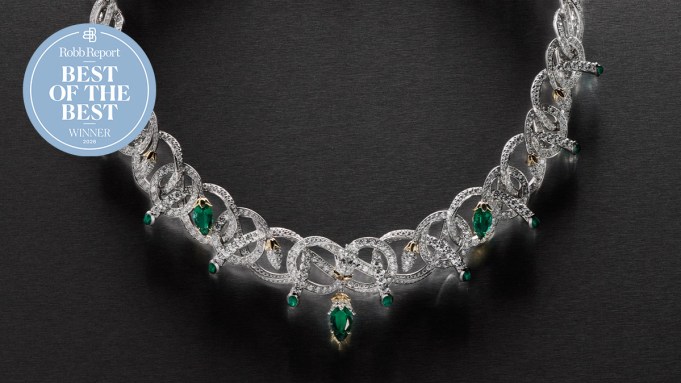
Technique: Tiffany & Co. Platinum, Gold, Diamond, and Emerald Necklace
Image Credit: Photographed by Quentin Lacombe/Styled by Dominika Kaczmarczyk In the 1950s and ’60s, famed Tiffany & Co. designer Jean Schlumberger was at the height of his creative output rooted in nature, its beauty examined in imaginative, elegant jewels. His Twin Bud motif was among those recognizable creations, capturing the fleeting moment just before full bloom. It was often rendered in sculptural gold figures and diamonds, frequently in the form of a brooch.
Now, senior vice president and chief artistic officer Nathalie Verdeille reimagines the theme into a complex high-jewelry creation of twisting, articulated vines set in platinum and 18-karat yellow gold, punctuated with three perfectly matched, unenhanced Zambian pear-shaped emeralds totaling 3.97 carats, alongside oval cabochon-cut emeralds and diamonds.
The intersecting links are deceptively simple. Platinum is notoriously difficult to work with, making the necklace’s fluid movement across interweaving links particularly challenging; each element must be set before final assembly. The combination of platinum and gold further demands precise mechanical integration to prevent stress at the joints, as the metals respond differently to heat. Take it as testimony to Tiffany & Co.’s own budding journey under Verdeille’s vision—one that honors Schlumberger’s codes while advancing them through technical rigor.
Vintage: Symbolic & Chase Ruby and Diamond Necklace
Image Credit: Leo Bieber On London’s old Bond Street, amid the grand jewelry houses, there’s a discreet upstairs gallery without any signage. Inside is one of the industry’s most influential figures: Martin Travis. When a European aristocrat wants to quietly sell an heirloom, he is the man they call. Family offices turn to him when diversifying into museum-worthy jewels. Collectors seek him out for everything from a rare Egyptian Revival design to a contemporary piece by the elusive maker Theodoros.
Over more than two decades, Travis has built a tightly assembled selection that ranges from ancient intaglios to Art Deco gems, alongside coveted works by JAR and artist Daniel Brush. Each piece stands on its own yet reflects the curatorial eye.
The best advice he was given early in his career came from a dealer. “There will always be somebody with more money than you,” Travis recalls being told. “The only way you can win this game is to have more knowledge.” He took that seriously, approaching jewelry almost like a detective, studying objects closely and uncovering overlooked treasures others missed. Case in point: Mauboussin’s showstopping Art Deco necklace dripping with large Burmese-ruby beads and diamonds.
Sapphires: Harry Winston Sapphire Earrings
Image Credit: Harry Winston Mr. Harry Winston handled some of the world’s most extraordinary sapphires, including Catherine the Great’s sapphire, a 337.10-carat oval stone frequently worn by the Russian empress. After her death, it remained part of the Russian Crown Jewels for more than a century before being sold. In 1948, Winston acquired the gem and, true to his mission to share great stones with the world, included it in his famed Court of Jewels tour from 1949 to 1953, which raised funds for charity. Alas, it was ultimately sold to an unnamed collector in 1962. Yet Winston’s passion for pursuing and showcasing rare gems lives on in this pair of Art Deco–inspired earrings, each centered on a remarkable 11-carat Sri Lankan sapphire, from the Art Deco suite.
Gold: Ana Khouri Gold and Diamond Collar
Image Credit: Photographed by Quentin Lacombe/Styled by Dominika Kaczmarczyk “I finally cracked that code,” declares Ana Khouri, who experimented for three years with different metal alloys to create her own 18-karat Fairmined brown gold. “There’s something feminine about brown gold—it feels closer to earth tones and pairs beautifully with white diamonds,” the Brazilian-born designer says.
Trained as a sculptor, Khouri approaches jewelry as a study in form and balance. In this brown-gold collar, the metal is twisted and hand-textured to resemble branches, with an 8.67-carat oval diamond appearing to hover at its center. The effect is deliberately minimalist against the intricate metal: The stone commands attention while quietly resting on the collar, like a pebble in a river.
Mixed-Media: Glenn Spiro Amber and Turquoise Necklace
Image Credit: Glenn Spiro Years of sourcing in the making, Glenn Spiro’s Materials of the Old World collection continues to turn out extraordinary creations from stones and artifacts rooted in ancient civilizations. The London-based jeweler’s unique eye spins these centuries-old objects into new masterpieces, and this amber, turquoise, and diamond necklace is the latest example of his vision. Amber has been used in jewelry for some 14,000 years, and in Roman times it was often valued more highly than gold in weight. Turquoise has been mined and worn since 5,000 B.C.E., and is thought to have originally been discovered on Egypt’s Sinai Peninsula. So, the two were fitting companions in a tribute to jewelry’s earliest origins. “We’ve always said the stones and materials come first,” Spiro says. “From there, it’s our job to take a risk.”
Blending the two stones in such a bold arrangement paid off. It’s an arresting combination: sizable, elongated amber beads totaling 158.75 carats, accented with rows of rectangular cushion-cut diamonds weighing 16.04 carats and interspersed with 136.15 carats of old-mine turquoise beads. Spiro describes his process as “bringing together color and character in a way that gives a piece life, to adorn a woman.” Just as appealing today as thousands of years ago, these stones prove that the earliest decorations still hold their power—only now reimagined through Spiro’s distinctly modern lens.
Pearls: Santi Chandelier Earrings
Image Credit: Sarah Gatenby-Howells Private jeweler Krishna Choudhary is known for creating pieces that stand out not only in design but also for their exceptional stones and materials. These Chandelier earrings exemplify that outstanding vision. Inspired by the draping of jewels on the Maharaja of Patiala’s turban, they are set with two Golconda diamonds—one totaling 8.88 carats and the other 9.31 carats—and flowing strands of natural Basra pearls connected with two baguette-cut diamonds on each earring, both of which are completed with pear-shaped diamonds set upside down. The rarity of the gems cannot be underestimated: Basra pearls originate from the Persian Gulf, and were largely depleted in the early 20th century, while Golconda diamonds from India are so scarce that they seldom appear at auction, and often years apart. For a bona fide jewelry collector, these are easily a grail that will never be replicated.




View the original article here


