


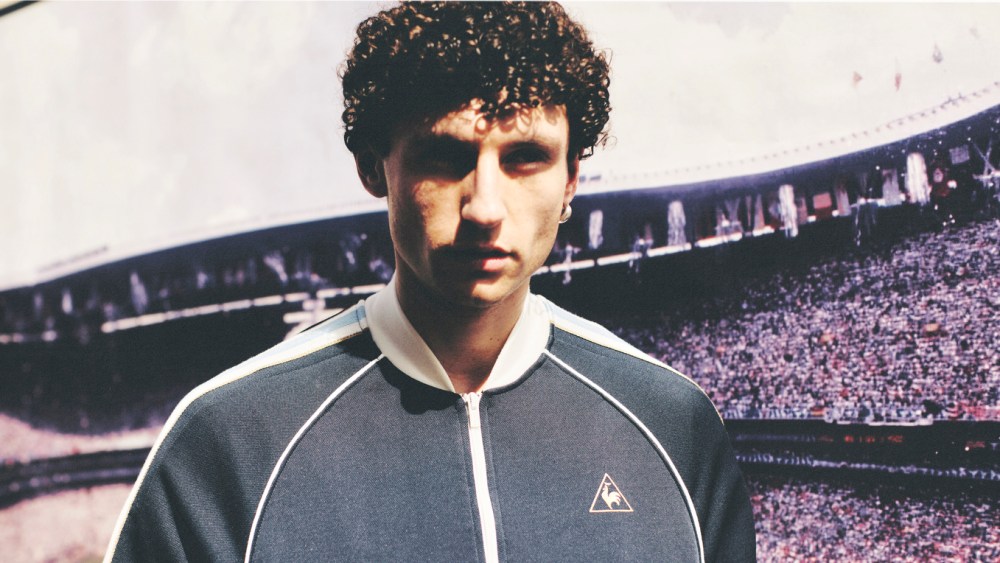

PARIS — As the 2026 FIFA World Cup enters its second week, Le Coq Sportif is celebrating a seminal moment in soccer history with a capsule dropping Monday.
That will mark 40 years to the day since the 1986 match that saw Argentinian player Diego Maradona score the infamous goal that became known as “The Hand of God,” the first of two goals that won the quarterfinal match against the U.K.
The French brand supplied Argentina’s ‘86 kit and the eight-piece capsule that drops 40 years on is of course built around the off-white, sky blue and deep slate colors of the “Albiceleste,” the nickname of the country’s national football team.
Described as a head-to-toe wardrobe “built to take you from the pitch to the street without looking like you made the journey,” the lineup spans T-shirts, jerseys, a zip-up hoodie, sweatshirt, shorts and trousers.
The capsule also serves as a teaser for the launch of Maradona Official, a brand created under license by Electa Global in collaboration with the estate of the late soccer legend led by his five children.
A look from the Le Coq Sportif x Maradona capsule.

Courtesy of Le Coq Sportif
“Diego is the biggest name the game has ever produced, and we’re building something the size of his legend,” said Ash Pournouri, founder of Electa Global and the Maradona brand. “Le Coq Sportif made the legendary ’86 kit, so this partnership starts with soccer history on its side.”
For Le Coq Sportif’s chief executive officer Alexandre Fauvet, Maradona is “one of those rare names that transcends football entirely.” With the French brand’s founding conviction that “sport and culture are inseparable,” the collaboration was a no-brainer.
The capsule will debut at the brand’s Boulevard Saint Germain flagship in Paris, which will be turned into “a living tribute” to the soccer star for the occasion, and on the French brand’s website.
Monday’s launch is also the first major step in the French athleticwear brand’s turnaround after a bruising period following the Paris Olympics in 2024.
Despite the high visibility during the Games, where it provided uniforms for the French Olympic teams, the company known for its rooster logo faced consecutive quarters of losses and was sued by the French Rugby Federation over unpaid fees from jersey sponsorship. It was placed in receivership in November 2024 when its Swiss parent company Airesis, which owned a 75 percent stake in the brand at the time, applied for judicial restructuring at the Paris Commercial Court.
Acquired in July 2025 by a consortium led by French-Swiss investor Dan Maname, the company tapped Fauvet, who logged almost a decade as CEO and minority investor of ski brand Fusalp. He’d also briefly advised Le Coq Sportif’s previous owners in the run-up to the Paris Games.
Under the new ownership, the company initiated its turnaround.
According to filings at the Troyes Chamber of Commerce, losses slowed to 3.6 million euros in the second semester of 2025, down from 20 million euros in the first half. Losses in 2024 had reached 60 million euros, with a turnover of 109 million euros.
The brand kicked off 2026 by dressing the French teams once more for the 2026 Milano Cortina Olympics and continued the year by unveiling in March a “reset” overhaul of its visual identity and a new site with international e-commerce.
It also tapped a creative director, multihyphenate industry veteran Pascal Monfort, whose track record includes being consumer culture and innovation director at Nike; fashion and image director at sports newspaper L’Équipe tasked with the revamp of its Sport & Style weekend supplement, and founder of Paris-based trends marketing agency REC.

Pascal Monfort and Alexandre Fauvet
Meyabe Ababacar/Courtesy of Le Coq Sportif
Le Coq Sportif’s potential was immediately evident for the new creative leader. “I don’t know anyone who doesn’t know the brand,” he told WWD in a joint interview with Fauvet. “But when I look at the revenue, it’s global notoriety with the turnover of a niche brand.”
In his eyes, the missing link is “desirability [that] will come through the product.”
As a blueprint for this new era, Monfort described “a triangular brand essence” that combines an “irresistibly French” aura; a collaborative “teammate” mindset, and a “full forward” push into the future, although the archives remain a key to rediscovering the brand’s spirit rooted in the invention of the modern tracksuit in the 1930s by Emile Camuset, a French underwear manufacturer.
Equally important to this heritage are “the individuals who shaped the brand,” such as Maradona and tennis players Yannick Noah and Arthur Ashe.
“They are personalities who stand out not because they have won plenty of championships or tournaments — Diego only won once — but they left their mark,” Fauvet added. “I think this is super interesting.”
Keeping at it against all odds is the kind of spirit Fauvet and Monfort telegraphed.
While the Paris Games marked a dark period for the company, they also crystalized a vision of sports that includes seeing that “the city is the stadium,” as the CEO put it. It matches a brand that is “not about aesthetics, not about winning at all costs,” he said. “It is really about a form of emancipation, of well-being for oneself.”
Another asset up its 144-year-old sleeve is that “the brand has accompanied all sports, collective and individual, which is really rare,” Fauvet added. “It’s also the only brand that is balanced on textile and footwear, the two pillars in terms of business, and speaks equally to men and women.”
Production in Romilly-sur-Seine, a city in central France about 90 minutes outside of Paris, allows for small-series runs of up to 400 pieces with international distribution. There will likely be further developments shown at fashion weeks in the fall and by early 2027 the brand plans to present denser made-in-France men’s and women’s collections.
For Monfort, this trajectory will prove “we can do things thought, imagined, designed and produced in France, an hour and half outside Paris,” he said. “It adds magic and we know that internationally, this has value.”
The French company’s goal is to top 150 million euros in sales by 2028, with a third of the business coming from the U.S. In the meantime, its spring 2027 orders are up 50 percent.
Early signs are encouraging. Fauvet said that the U.S. market, where Le Coq Sportif has not been present with physical distribution for many years, has emerged as the second largest after France, particularly since the e-commerce launch.
While that’s only a 10 percent share of the business currently, it happened “without any marketing activity” targeting the territory. That’s set to change in September, with an initiative in New York on the cards.
“We are going to offer Le Coq Sportif again the commercial, reputational and prestige success that the brand deserves,” said Monfort. “That is our only mission.”

A look from Le Coq Sportif’s relaunch.
Courtesy of Le Coq Sportif
View the original article here


