


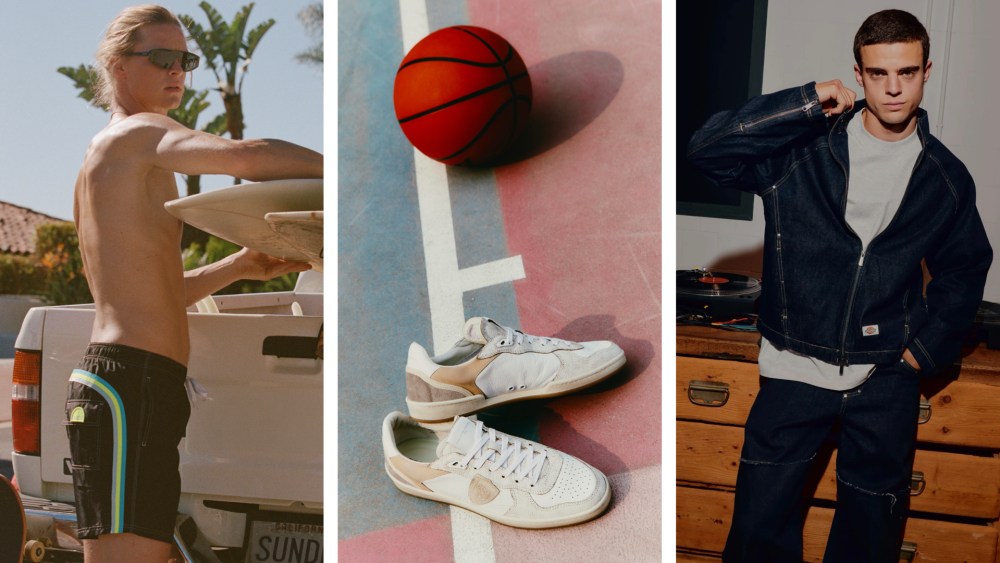

The year 2025 will surely be remembered for the sweeping creative reset that reshaped the fashion industry. It also marked a pivotal year for many companies in the premium and contemporary luxury segments, as they changed hands and their new owners moved to retool offerings and strategies in hopes of reenergizing sales.
Some are now facing their first stress test at this week’s menswear trade show Pitti Uomo, the preferred stage for unveiling their new direction under new leadership.
Here WWD takes a look at what lies ahead for Sundek, Dickies and Philippe Model Paris.
Sundek
When the Turin, Italy-based BasicNet took over beachwear specialist Sundek last December from Winnie Srl, it came with little surprise.
The label, founded in San Francisco in 1958 by Stuart Levin, aligns with the new owner’s track record of revamping heritage brands with a cool undercurrent through a lifestyle proposition.
A key player in the rise of Californian surf culture that has embodied the values of freedom and community resonating with that lifestyle, Sundek grew into a powerhouse in the swimwear segment, expanding from the California coast to Hawaii, the East Coast and internationally.
After its peak in popularity in the 2000s, especially for its iconic Rainbow Boardshorts, cut from fast-drying nylon, seamless, marked by the signature rainbow stripes on the back and available in every Pantone shade, Sundek slowly slipped out of the zeitgeist.

But BasicNet is committed to reverse the course.
“There is no brand in the market quite like Sundek. There are brands that cover parts of this business, but none that brings the full picture together,” said Lorenzo Boglione, co-chief executive officer at BasicNet, a title he shares with his brother Alessandro.
“We’re flipping the paradigm as we see Sundek as a brand first — not simply a swimwear brand — one that expresses a California lifestyle across the beach, the countryside and the city, with roots firmly grounded in an outdoors-driven mindset. The product is easy, simple and authentic, but also highly wearable and commercially viable,” he said.
A preview of the Sundek boardshort designs for spring 2027.
Courtesy of Sundek
“We see strong potential, what we have seen in the collection is genuinely compelling. That is why we believe strongly in building a distinct look, image and style, in creating a set of references that can shape both the [current] business and [new] categories that do not necessarily exist today — becoming the destination for customers who want this specific lifestyle,” he said.
“Strategically, the sky is the limit. Sundek can play in swim, lifestyle and even winter. The focus is California, not surfing culture per se, although surf remains an important part of the lifestyle ethos. It may take 10 years, but that is the time frame we set for our brands,” Boglione added, acknowledging that the business had been under pressure in part for lack of clarity in positioning and strategic direction.
Debuting under the new ownership Sundek chose to unveil its spring 2027 collection at Pitti Uomo this week.

A preview of the Sundek Goldenwave men’s spring 2027 collection.
Courtesy of Sundek
“The fair is always a very important platform for us to introduce something new,” Boglione said. “It is also the right place for a reset — the ideal stage to shift gears and signal a new direction,” he noted.
The collection will introduce a rebooted version of the Goldenwave line, rooted in vintage-nodding swimwear, apparel and accessories, defined by a washed color palette and distressed finishes inspired by the maritime pictures of LeRoy Grannis in the ‘60s. The Original range, hinged on the signature boardshort, will welcome new colorways, as well as a collaboration with Japanese illustrator Kentaro Yoshida, whose designs will appear on swim trunks, sweatshirts and T-shirts.
Sundek operates 25 stores and five outlets across Italy, primarily, as well as Spain and France. Boglione said some “rationalization” is in the pipeline, but a new store has already opened in Turin, although a broader retail plan will be unveiled in 2027.
Largely wholesale-dependent, the brand has opportunities for expansion in France beyond the Côte d’Azur, as well as Greece and the U.K., Boglione believes.

A preview of the Sundek Goldenwave men’s swimming trunks for spring 2027.
Gabriele Facciotti/Courtesy of Sundek
“This is a business where we can see the opportunity while also understanding that it takes time. We are preparing to set the ground for the business to thrive regardless of short-term revenue,” Boglione noted. “That said, we do believe we can generate growth in the near term because we have strong conviction in the product we are developing.”
It’s a whole new world for Dickies.
The brand, originally called the Williamson-Dickie Manufacturing Co., was founded in 1922 in Fort Worth, Texas, and got its start making denim bib overalls for farm and ranch hands. Over the years, it became a staple of American workwear and in recent years, it expanded into streetwear and became a favorite of skateboarders who were drawn to its durable products.
Today, it’s available in more than 100 countries and continues to successfully blend its heritage in workwear with popular culture across fashion, music, skateboarding and streetwear.
Last year, VF Corp., which had owned by brand since 2017, sold Dickies to Bluestar Alliance for $600 million in cash as part of its plan to pare down its portfolio. Bluestar, which has a strong brand management business, tasked Sportlux to be the brand’s European operator.

Dickies hosted a three-day immersive event in Milan in May.
Courtesy
Sportlux has already started promoting the brand aggressively in Europe. In May, it unveiled “From Industry to Icon,” a three-day takeover of the Wivian Factory in Milan for the presentation of the spring 2027 collection. The goal of the project was designed to evolve Dickies into a more culture-driven and community-focused brand while staying true to its workwear DNA.
For the three days, the company transformed an industrial space into an immersive platform featuring projections, live performances and temporary installations.
And now, Dickies is preparing to make its debut at Pitti Uomo. From Tuesday to Friday, the brand will be housed in a dedicated 155-square-meter space in the Sala Ottagonale.
“Dickies at Pitti Uomo is a clear market signal at a pivotal moment for the brand: more focused in product, stronger in execution and ready to grow again with the right partners,” according to Bluestar. The objective is to reconnect with key accounts, engage targeted new partners across priority markets and distribution channels, and demonstrate the brand repositioning through a sharper and more commercially usable product offer.”
At the show, Dickies will present its signature products as well as the spring 2027 collection, and the brand will also outfit the entire Pitti Uomo staff during the show.

A look from the Dickies spring 2027 collection.
Courtesy of Dickies
Key pieces within the spring collection will include denim in expanded fits and new washes as well as an expanded offering of a clearer and more defined womenswear offering.
Bluestar has quietly been building its portfolio. Last year, it acquired Palm Angels and it also owns Off-White, Scotch & Soda, Hurley, Tahari, Bebe and several other labels. The company was founded by Gabbay and Ralph Gindi in 2006 and manages a portfolio of more than 500 licensees globally.
Philippe Model Paris
Under its new owner Swinger International, which acquired it last December, Italian brand Philippe Model Paris is headed to Pitti Uomo.
“Pitti Uomo wasn’t a random choice, but a strategic necessity. It’s not a trade fair, but a trend laboratory where buyers, international press and opinion leaders meet to validate brands’ new directions,” said Mathias Facchini, president of the Italian fashion group.
Through the acquisition, the group wants to consolidate the brand’s position in the premium casual luxury segment and accelerate its international expansion. It plans to strengthen the brand’s presence in existing markets such as Europe, the U.S. and Asia, focusing on three key pillars: stylistic renewal and expanded offerings; new storytelling and a communication strategy targeted toward a global audience, plus a distribution strategy for long-term growth.

Philippe Model Paris
Courtesy of Philippe Model Paris
The core of this strategy is “transforming Philippe Model Paris from a product brand into a true lifestyle brand” by introducing apparel in the medium term, Facchini said. “This shows the brand isn’t just a ‘fashion brand’ but a lifestyle brand. Philippe Model Paris is now presented as a brand with a story, artistic identity and positioning that attracts consumers seeking exclusivity,” he said.
This concept will be in full display at the fair, where the brand will mount its booth on the Ghiaia Courtyard at the center of the trade show’s Fortezza da Basso venue. The collection will be presented via artistic storytelling with installations inspired by Philippe Model, the namesake Parisian designer and artist who founded the brand in 1978.
“In today’s luxury landscape, where product quality is often taken for granted, desirability comes from a brand’s ability to build a meaningful universe that consumers want to identify with,” Facchini said. “Strong, consistent storytelling creates identity differentiation: it makes the brand unique and less dependent on pricing alone,” he said.
“Swinger International’s ambition has never been to be only a brand management firm, but to position itself as a strategic hub to foster the growth of companies within its ecosystem,” Facchini said about the group’s approach. “The acquisition of Philippe Model Paris demonstrates that we can successfully integrate brands with strong heritage and clear recognition,” the executive said.
Swinger International’s plan for the footwear brand includes retooling its manufacturing capabilities through streamlined supply chain management, centralized oversight for enhanced production control and preservation of manufacturing standards.
Swinger International acquired Philippe Model Paris from 21 Invest for an undisclosed sum last December. The latter investment firm — then called 21 Investimenti and founded in 1992 by Alessandro Benetton — had taken a majority stake in the footwear brand in July 2016.
Based in Verona, Italy, Swinger International also owns the Genny womenswear brand and produces the Just Cavalli and Versace Jeans Couture collections under license. It also recently invested in the Etro brand with Rams Global and SRI Group.
View the original article here


