



The latest guest designer at Pitti Uomo is neither a heritage house nor a promising newcomer throwing their hat in the sartorial ring.
If anything, DSM Kei Ninomiya is a UFO.
First, by virtue of its founding principle as a newfangled take on private label merchandise from the Dover Street Market retail emporium that is the brainchild of Rei Kawakubo and Adrian Joffe. At the brand’s launch, it came with a tagline that read “Untitled, Untethered, Undefined.”
And it’s certainly not Ninomiya, the first to step up to the plate, who will break rank by establishing boundaries.
When asked what kind of wardrobe he is building with the label, now in its third season, he resists narrowing the focus to a single tribe. At the heart of DSM Kei Ninomiya is community, congruent with the unique array that gravitates around Dover Street Market.
“It’s not only one style,” Ninomiya told WWD. “We go based on [Dover Street Market’s] philosophy or aesthetic, but we focus on a different community for each collection,” with his first two efforts taking cues from the collegiate and soccer worlds.
Front and center for the brand’s runway debut Wednesday at 10 p.m. at the Sant’orsola convent-turned-museum in Florence is a community centered around music, especially punk. But that’s not shorthand for tartan bondage trousers or other trappings of the subculture.

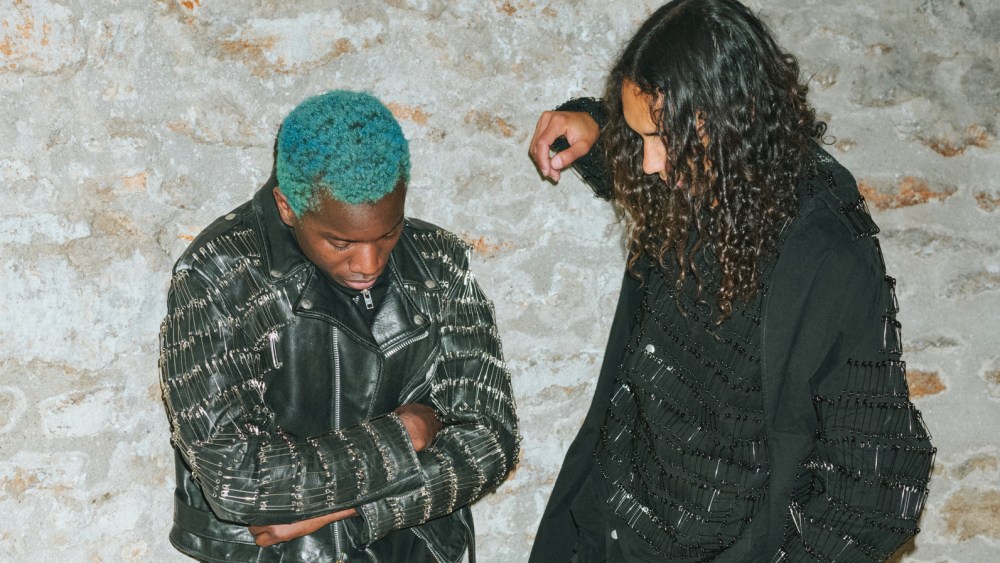
A look at the DSM Kei Ninomiya collection showing at Pitti Uomo.
Hugo Veuillet/WWD
At a collection preview in Paris, there might have been safety pins galore, but these came tone-on-tone, arrayed in neat rows that skewed more couture-like embellishments than rebellious modifications.
From the outset, the Tokyo-based designer has anchored his chapter under the Dover Street Market banner as “real clothes, not image,” in a departure from his work at his label, Noir, where he favors conceptual silhouettes rife with technical experimentation that border on the otherworldly.
In DSM Kei Ninomiya, “product is very important,” he said. “Even when the concept is strong, it’s wearable things, like a wearable object.”
On equal footing to him are “fabric, sewing, silhouette, pattern,” he continued. “I work with everything together.”
While he demurred on spilling too many beans on his spring 2027 lineup, a handful of pieces during the preview included leather jackets tooled just so, oversized shirts, and trousers hitting an appreciable note between tailored and utilitarian with zips at the ankle and a curving leg. Black leather slip-ons and low-top sneakers, both courtesy of a collaboration with Vans, completed the looks.
But while punk may be most identified with music, to Ninomiya, it also represents “an attitude to creation,” one he follows in his work. Its plurality is also a draw for him. “Punk has many meanings,” he said. There’s “a strong side,” in terms of aesthetic, as well as an anti-establishment stance, but there’s also another side that resonates with Ninomiya.
“They care about minorities, about people, it’s not only about money,” he said. “It’s really more open to the people. I really like [that].”
That dovetails with Dover Street Market’s fundamental concept — “that it’s open to everybody, all ages, rich and poor — everybody,” said Joffe, who is president of Comme des Garçons International and chief executive officer of Dover Street Market.
For him as well, punk is “definitely an attitude,” he said. “I think it’s also mostly about not accepting established norms, [being] anti-establishment, and freedom.”
Rules and expectations “are not necessarily creative, in the sense that you don’t make progress,” he continued. “It stops people being themselves, being free [punk] gives you the freedom to express yourself in the best way.”
And with the world the way it is right now, “we need more punk,” Joffe added.
Take the fashion industry, where a moment rife with economic uncertainty, conservative moods and a less aspirational view of luxury has many players tilting toward caution.
“We think it’s the very moment that you can be more free and take more risks,” Joffe said.
Despite initial reluctance owing to his observation that “in-house labels never ever worked — any shop that’s tried to do their own label, it’s always been so boring, it’s so safe” — the DSM brand launched.
Such an endeavor inevitably raises the idea of merch — the caps, hoodies and tote bags that have proliferated from luxury houses to museums, art fairs and neighborhood restaurants.
“I don’t think merch is a dirty word,” the Dover Street Market CEO said. “I think it’s cool.”

A look at the DSM Kei Ninomiya collection showing at Pitti Uomo.
Hugo Veuillet/WWD
Yet as “every Tom Dick and Harry wants to do a hoodie and a tote bag” as he put it, the point is not to reproduce the lowest common denominator but to use the same accessibility to underwrite more adventurous expressions.
That egalitarian streak runs through the approach to the DSM brand’s distribution. Where others tighten control by reducing wholesale and chasing exclusivity, Joffe is pushing in the other direction.
“I think it’s too controlled these days,” he said. “It’s nice to be free, it’s nice to be inclusive, not exclusive; I want everybody to have it. It’s not about who has it, or has a special color. I don’t like all that.”
Wholesale, in his view, should be a conduit for local interpretation, not a risk to be minimized. “What makes the difference is how they sell it, and tell the story in relation to what they do,” he said, seeing opportunity in letting retailers “be free to take something that you make and do it in their way.”
So far, the gamble has paid off, as Joffe said the label had doubled its business in its second year and is projected to double again.
A fresh bet was staging the debut runway show for DSM Kei Ninomiya at Pitti. Initial concerns about being too early into the brand were overruled by a desire to take the risk because “it’s always worth it to take risks and you can’t really achieve much without taking [any],” Joffe believes.
It was also an opportunity to push the conceptual beyond the quiet approachability of his first two seasons with DSM Kei Ninomiya.
“We did say to him [that he’s] got to really go for it this time, it’s got to be not just a nice collection of clothes, [but express] his strong point of view,” Joffe said. And with “the way punk spirit comes out in his own collection,” Ninomiya’s embrace of the movement in the spring lineup he’ll show in Pitti turned out “really authentic, with real old-punk people.”
While specifics remained under wraps, Joffe and Ninomiya separately hinted at an immersive moment in the historic Florentine venue. A Jamie Reid visual offered the tantalizing possibility that it might include the legendary British visual artist.

A look at the DSM Kei Ninomiya collection showing at Pitti Uomo.
Hugo Veuillet/WWD
Looking ahead, Ninomiya is cautious about predicting whether runway will become a fixed format for the label. “Nobody knows,” he said with a laugh.
What he is sure of is that Wednesday’s upcoming show is “a good opportunity to show new clients and existing ones what Dover Street Market Kei Ninomiya is,” the designer added.
What he feels is “the important point [is] that they’re interested, that they feel something from my collection.”
In today’s fashion landscape, that may be the most punk position of all.
View the original article here


